


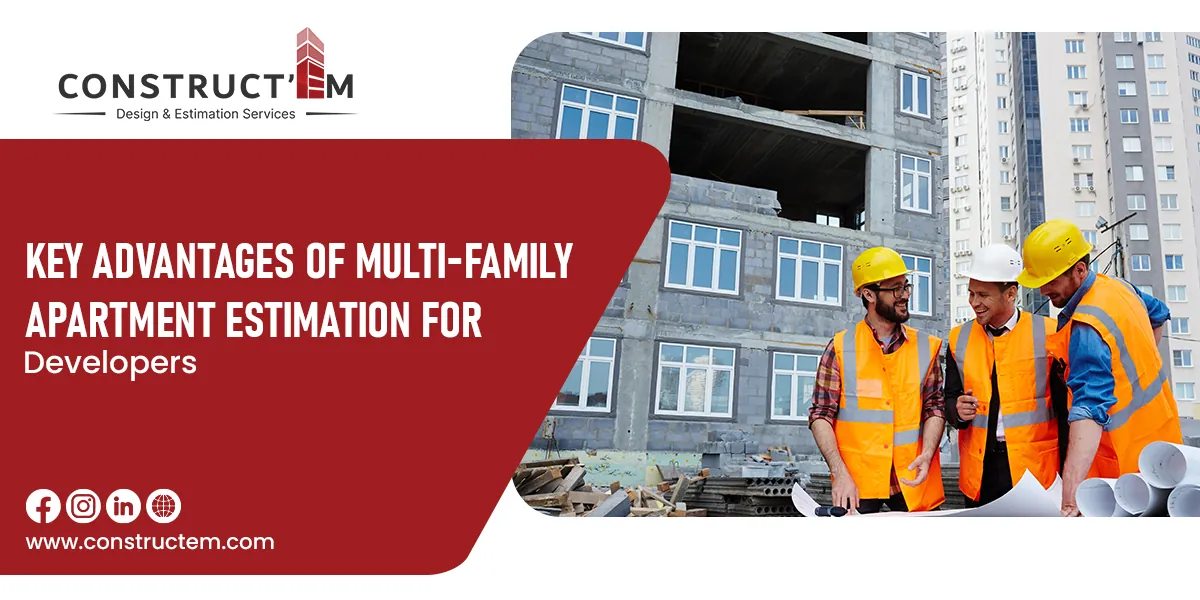
Did you know that a staggering 98% of large-scale construction projects suffer cost overruns exceeding 30% of their original budget? According to recent McKinsey & Company industry reports, nearly 77% of these projects also finish at least 40% behind schedule.
In the high-stakes world of US real estate, Multi-Family Apartments Estimation is the strategic heartbeat that keeps your project on track, on budget, and on time. The first step for any developer aiming to stay in control is understanding how multi-family cost estimation works.
Multi-family apartments estimation is the process of predicting the total cost of a residential project before construction begins. Think of it as a financial GPS that tells you exactly how much fuel you need to reach your destination. This process involves more than a simple price tag. It requires a deep dive into every corner of the project, from specialized labor rates to local permit fees. In the USA, a multi-family apartments estimation takeoff serves as the backbone of this process. It provides a detailed list of every physical material required, ensuring that no rebar or light fixture is left unaccounted for.
To get an estimate right, you must address the essential pillars. Furthermore, accuracy depends on:
Why do the best construction estimators in the US emphasize this step so heavily? Because the benefits ripple through every stage of the project.
Lenders are more cautious than ever in 2026. If you walk into a bank with a vague budget, you will likely walk out empty-handed. However, a professional estimate proves the project is viable and significantly reduces their risk.
Nothing kills a project faster than a massive budget gap in the middle of construction. Accurate estimation catches these discrepancies early. Consequently, you can adjust your design or find alternative materials before you have spent a dime on actual construction.
When you know your costs down to the penny, you can price your units more effectively. This allows you to perform “value engineering” that finds ways to provide luxury finishes at a lower cost. Ultimately, this directly inflates your bottom line.
For contractors, a precise estimate ensures your bid is low enough to win but high enough to maintain a profit. It removes the guesswork that often leads to winning a job only to lose money on it later.
While spreadsheets may seem sufficient, multi-family projects involve significant complexity. A professional estimator acts as a bridge between the architect’s vision and the contractor’s reality. They understand local zoning laws in different US regions and know how to navigate supply constraints in high-growth areas. These experts use multi-family apartment takeoffs in the USA standards to ensure no regional regulation catches you off guard. Instead of just giving you a number, they provide a comprehensive strategy for success.
Skipping a detailed estimate is like sailing a ship without a compass. While you might stay afloat for a while, you will eventually hit the rocks.
Technology now transforms estimation work into a scientific process which eliminates the need for traditional paper blueprints and highlighters.
Many developers try to handle estimation in-house, but this is risky for large-scale complexes. Outsourcing to the best construction estimators in US gives you an unbiased, third-party look at your project. These external firms have access to massive databases of historical costs that most developers do not possess. Moreover, it frees up your time. Instead of squinting at spreadsheets, you can focus on finding your next big deal. It is a small investment that pays for itself ten times over by preventing a single major mistake.
The 2026 housing market contains numerous opportunities yet presents multiple dangers which await those who fail to prepare. Multi-Family Apartments Estimation service protects your business from inflation, labor shortages and unplanned project delays. Your decision to invest in a professional estimate establishes trust between you and your lenders and partners and upcoming tenants. Your project must not end up as another cost overrun case instead take command of your financial data today to achieve complete certainty before breaking ground.
The process involves predicting all construction expenses which must be determined before construction begins. The precise calculations which you need include material costs and labor expenses because they will help your project maintain profitability while avoiding unexpected costs during the building phase.
The 1% rule shows that a property should generate monthly rent which equals at least 1% of the total purchase price. Investors use this tool as a fast method to assess potential cash inflow.
A multi-family apartment building consists of one residential structure which provides multiple families with separate living accommodations. Each unit contains its own kitchen and bathroom and living space which exists within a single building structure.
The process begins with a thorough examination which will determine necessary structural improvements and unnecessary cosmetic enhancements. The next step involves obtaining current pricing information for all needed materials and labor costs while establishing a 15% contingency fund to cover unforeseen expenses.
The required down payment amount varies significantly based on the type of property being purchased. Owner-occupiers may qualify for as little as 3.5% through FHA loans, while strict investment-only purchases typically require 20% to 25% down to secure favorable rates.


Social Links
© Construct'EM - 2026. All rights reserved.