
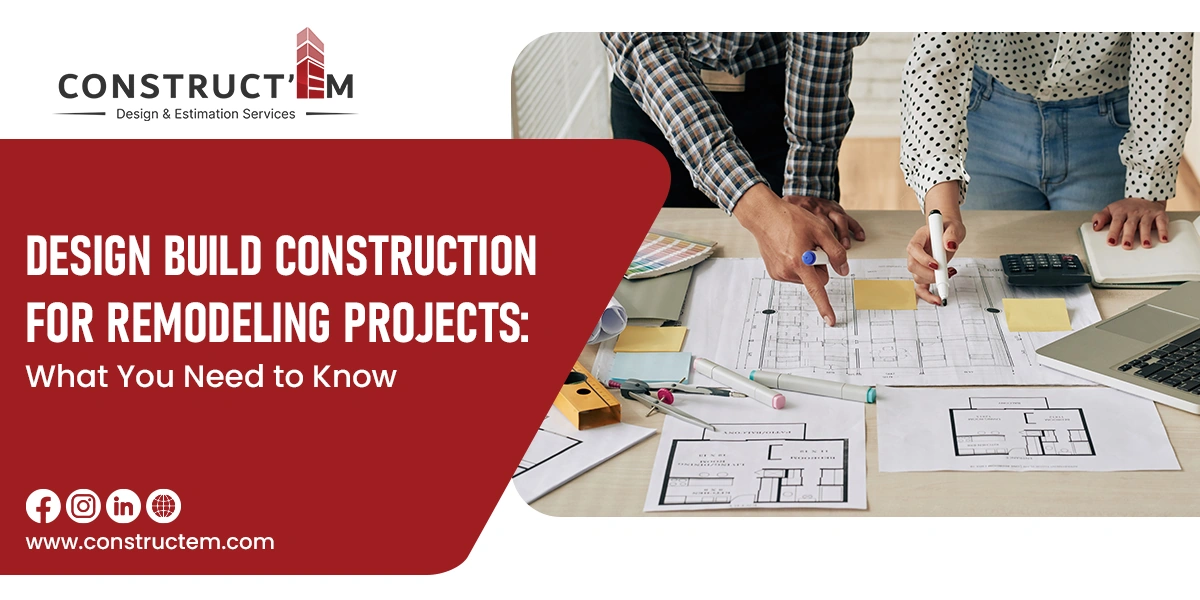
According to a report by the Construction Industry Institute (CII), traditional construction projects often see a 5.2% increase in costs purely because of design errors and mid-project changes. Imagine pouring your savings into a kitchen remodel, only to find out halfway through that the architect’s blueprint is a structural nightmare that your contractor cannot actually build. This disconnect often leads to a “blame game” between the designer and the builder which is the main reason home projects go over budget and stall for months.
To solve this, more homeowners are turning to design build construction. This model puts the entire remodel under one roof, and that kind of collaboration can make all the difference. Let us break it down for you.
Think of design-build like a pit crew in racing. Everyone from architects and engineers to builders and cost estimators is in the same garage, working together.
In traditional remodeling, architects draw plans, then hand them to a contractor. And miscommunication, delays, and unexpected costs can creep in. With building design consultation, the team catches potential issues early. For example, if an old floor can’t hold the weight of a new kitchen island, the contractor flags it immediately. According to DBIA, this approach often means faster builds and more predictable budgets, which is huge for remodeling projects full of unknowns.
A successful remodel doesn’t happen by accident. In the design-build world, we follow a structured path to ensure the final result matches your vision without hidden financial surprises.
During this phase, designers translate the wish list into rough sketches. We focus on spatial relationships and the general “vibe” of the remodel.
Here, the sketches become technical drawings. We select materials, finishes, and specific fixtures. Because the builder is involved at this stage, they provide real-time feedback on material availability and labor costs.
The team produces the final set of drawings used for permits and actual construction.Even small inaccuracies at this stage can significantly affect your budget, which is why understanding how building architectural drawings impact the overall cost of construction is so important.
Since the design builder is already on board, the “bidding” is actually a finalization of the construction cost estimation. We submit plans to local authorities to ensure everything meets safety codes.
This is the transition from paper to power tools. The designer and building design consultation providers stays involved to ensure the construction team executes the aesthetic details exactly as planned.
The biggest advantage of design-build is absolute accountability. When one team owns the project, there is no one else to blame for errors, which forces a higher level of precision from day one.
The integrated method eliminates various traditional difficulties because it solves most problems. The following procedures explain how to identify various problems and create their solutions before they occur.
Even within a single firm, creative designers and technical site crews can sometimes speak different “languages.” If the handoff isn’t seamless, the vision you fell in love with during the 3D rendering phase might get slightly lost in translation once framing begins.
The Solution: Prioritize a firm that uses Integrated Project Delivery (IPD) software. This allows the construction team to access the live architectural models in real-time on the job site. At Constructem, we ensure our lead carpenter is present during the final design review to flag “buildability” issues before a single permit is pulled.
The excitement of selecting premium materials results in budgetary destruction through its implementation. Design-build projects make it simple to choose aesthetic elements which appear attractive but create hidden costs through custom design modifications.
The Solution:Request a Guaranteed Maximum Price (GMP) contract early. A professional estimator should provide a “Selection Allowance” sheet. The document establishes a spending limit for your kitchen project which includes flooring and fixtures thus protecting your financial boundaries.
The architect in traditional design functions as an external inspector who verifies the construction work performed by the contractor. The design build construction system establishes a unified team which consists of an inspector and a builder who operate throughout the project.
The Solution: Transparency is the antidote. Ensure your contract includes Open-Book Accounting and scheduled “Milestone Walkthroughs.” According to reports from the National Association of Home Builders (NAHB), the most successful projects are those where homeowners receive weekly photo updates and detailed line-item reports on progress.
Remodeling your home should be an evolution of your lifestyle, not a source of chronic stress. By choosing a unified team, you trade the chaos of fragmented communication for the harmony of a singular vision. At Constructem, we believe that when designers and builders speak the same language, the homeowner is the one who truly wins. Whether you are in the early stages of a building design consultation or ready to break ground, the design build construction path offers the most direct route to the home you’ve always imagined.
Design-build enables one company to deliver all design build construction work through a unified contractual agreement. This creates a “single point of responsibility,” meaning the homeowner only manages one relationship throughout the entire remodeling journey.
The most notable downside is the reduction in independent oversight between the designer and the contractor. Because they work for the same company, the homeowner must perform deep due diligence on the firm’s reputation and past client testimonials to ensure quality remains the priority.
The primary benefits include faster project completion combined with decreased owner administrative work and improved cost estimation accuracy. The early builder integration process helps the team find technical problems which they can solve at the office. This method saves construction time by preventing work delays which require expensive construction time.
The process typically moves through Schematic Design (sketches), Design Development (refining details), Construction Documents (technical blueprints), Permitting (legal approval), and Construction Administration (oversight). The design-build method combines these phases because it requires less time to complete projects.
While upfront design build construction fees are transparent, the total project cost is typically more stable and often lower than traditional methods. “Hidden costs” of design errors and change orders are the leading causes of budget overruns in traditional construction.

Social Links
© Construct'EM - 2026. All rights reserved.