

If you’ve been in the commercial building game for a while, you know that construction cost estimating used to feel a bit more predictable. You had your labor rates, your material quotes, and a standard contingency for “just in case.” But as we move through 2026, it has become “all the time.”
The landscape of commercial construction estimating has shifted. We aren’t just dealing with the occasional supply chain hiccup anymore, but navigating a world of high-tech data centers, strict green building laws, and a digital revolution in how we track every penny.
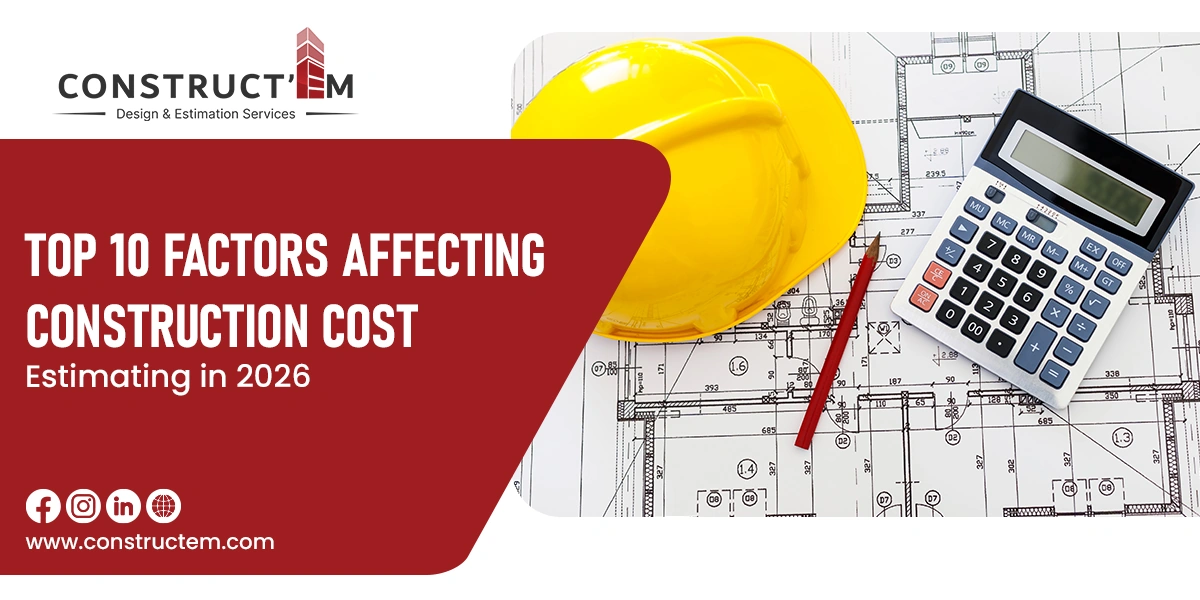
To help you keep your bids accurate and your margins safe, let’s dive into the 10 biggest factors hitting your construction cost analysis this year.
We aren’t in a simple “inflation” period anymore; we are in a “volatility” era. While overall inflation has cooled, construction-specific inputs for nonresidential projects have remained stubborn.
Industry reports from Deloitte suggest that even with a more stable economy, certain specialized materials are still nearly 40% higher than pre-2020 levels. Estimators are now moving away from fixed quotes toward “Index-Aware” pricing, where bids are tied to market benchmarks so they aren’t left holding the bill if copper or steel spikes overnight.
The labor shortage isn’t news, but in 2026, it has evolved into a demographic crisis. The Associated Builders and Contractors (ABC) recently stated that the industry must attract approximately 349,000 net new workers this year just to meet demand. Because nearly a quarter of the skilled workforce is nearing retirement, the cost of hiring a seasoned foreman has skyrocketed.
Trade policy is now a direct line item in every budget. Recent shifts in global trade agreements have pushed duties on structural steel and aluminum to significant highs sometimes up to 50%. Tariffs drove a “blistering” annualized cost increase of 7.1% for nonresidential inputs earlier this year. To protect margins, many firms are now including “Tariff Escalation Clauses” in their contracts.
AI is changing how we bid. Firms using AI for document review and data analysis are seeing overhead cost reductions, but the “Digital Upskilling” of the team is a new, necessary expense. Industry outlooks from PBMares highlight that while technology is a key lever to protect profitability, the initial investment in training and high-tech tools must be accounted for in your firm’s overhead. This shift also reflects the broader comparison between traditional and digital methods, as explored in Electrical Estimating Software vs Manual Estimating: Which is Better?
Nearly half of construction executives now classify their supply chains as “fragile.” To fight this, firms are moving toward “Strategic Stockpiling.” This means buying HVAC units or specialized glass six months early and paying for storage just to ensure they have the parts when they need them. A “Hedging” strategy is becoming essential, but it adds new costs to your estimate like storage fees and the financial drag of tying up capital in inventory.
In 2026, “building green” is no longer a luxury but a legal requirement. New environmental codes are requiring materials that are often more expensive, such as low-carbon cement or engineered timber. Atradius reports suggest that these mandates add layers to your construction cost analysis, as you now have to budget for compliance targets and specialized subcontractors who know how to work with these new “green” systems.
Scope creep is the #1 profit killer. In 2026, with financing being so tight, lenders are demanding more robust financial modeling and “Stage-Gated” baselines. Industry insights suggest that you can’t start the next phase until the costs for the current one are perfectly locked in. Using BIM (Building Information Modeling) to create a “Digital Twin” before you build allows you to catch design gaps in a virtual world where they cost nothing to fix.
While sectors like Data Centers are booming, others are shrinking and creating a “pressure cooker” environment. Oxford Economics notes that while global growth is returning, the market is uneven. This makes commercial construction cost estimating more vital than ever.
Smart firms have stopped looking at projects in silos. They are moving to “Portfolio-Level Governance,” where they manage costs across multiple projects at once to get better bulk pricing on materials. This shift allows larger firms to run a “tight commercial control loop,” managing liquidity and risk across their entire portfolio rather than on a single jobsite.
From “Social Inflation” (rising insurance costs) to extreme weather delays, where you build is as important as what you build. HUB International recently stated that 92% of organizational leaders believe rising costs including climate-related delays, will impact their profitability. If you’re building in an area prone to heatwaves or storms, your estimate must include a “Climate Contingency” to cover stop-work days and specialized safety gear.
Navigating 2026 requires more than a sharp pencil. It requires a sharp strategy. By understanding these 10 factors from the “Expertise Premium” in labor to the impact of global tariffs, you can turn a “best guess” into a bulletproof bid.
Ready to modernize your next estimate? For data-backed construction cost analysis that protects your bottom line, Contact Constructem today.
In 2026, delays usually stem from labor gaps, tariff-related material lags, or permitting snags. Toss in extreme weather and financing hurdles, and you’ve got the perfect storm that keeps projects from finishing on time.
It’s a mix of volatile material prices, rising wages, and new trade tariffs. We’re also seeing “green” legal mandates and the high cost of tech upgrades adding layers to the budget that weren’t there before.
Keep your eyes on your Net Profit Margin and Safety Rates. You also need to track your Schedule and Cost Performance Indexes (SPI/CPI) and your Rework Ratio to see where money is literally leaking.
Materials and labor still take the lead, but MEP (Mechanical, Electrical, and Plumbing) systems are catching up fast. With the AI data center boom, the tech-heavy parts of a building are becoming incredibly expensive.
AI-driven bidding and “Digital Twins” are the big ones for 2026. We’re also seeing more autonomous machinery on sites and 3D-printed components that help us bypass the local labor shortages that plague traditional builds.
The “Big Four” are definitely the lack of skilled hands, unpredictable material costs, strict new environmental laws, and banks being much more cautious with loans. It’s a tough balancing act for any project manager.


Social Links
© Construct'EM - 2026. All rights reserved.