

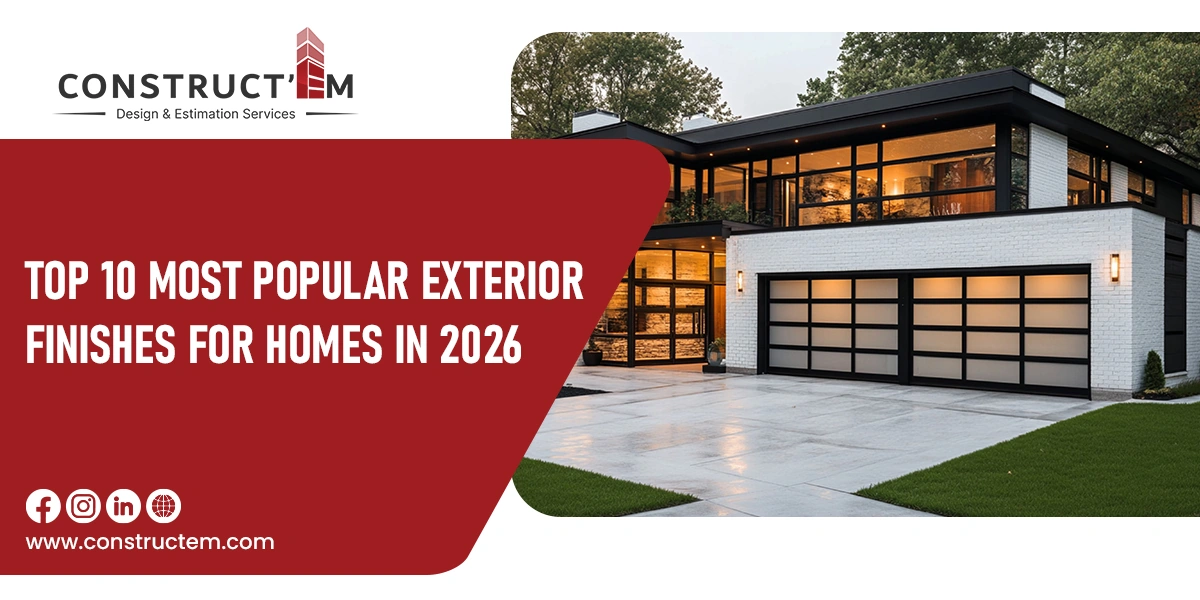
Nobody wants to spend $20,000 on a home exterior only to watch it crack, fade, or leak three years later. This gut-wrenching realization usually stems from picking a finish based solely on “the look” while ignoring the local climate and structural needs. We believe you shouldn’t have to choose between a beautiful home and a sound investment. To help you navigate the noise, we have compiled the definitive list of 2026’s top exterior finishes, balancing modern aesthetics with the technical durability that your property actually requires.
Stucco is still the king of the mountain in U.S. residential construction. If you look at the U.S. Census Bureau’s Survey of Construction (SOC), you’ll see it accounts for about 27% of new single-family homes. Beyond its clean, Mediterranean look, its real value lies in its fire resistance and how well it handles the thermal expansion typical in the Southwest. For a high-end application, a realistic construction cost calculation usually lands between $7 and $12 per square foot.
Vinyl is currently holding roughly 25% of the market. However, the 2026 “luxury vinyl” options provide advanced features which surpass the capabilities of previous cheap plastic materials. The new panels provide excellent results as they are replicating the appearance of cedar wood and matte metal surfaces. Vinyl siding is one of the most economical solutions for exterior home finishing nowadays because of its demand of no maintenance while delivering an elegant appearance.
Fiber cement has grabbed a 21% market share because it solves the rot and termite issues associated with wood. Brands offer pre-painted options that stay crisp for over a decade. In 2026, we’re seeing a massive pivot toward dark, matte tones like charcoal. While it’s a mid-to-high tier investment ($10–$18 per square foot), the lack of maintenance makes the ROI very attractive.
If your priority is exterior finishes that improve home insulation efficiency, EIFS is the undisputed leader. Unlike old-school stucco, EIFS uses a multi-layered system with integrated foam insulation. This essentially wraps the house in a thermal blanket. Data from the EIFS Industry Members Association (EIMA) shows these systems can cut energy loss through walls by up to 28% by stopping thermal bridging dead in its tracks.
Full stone is a luxury, but stone veneer has become the go-to for adding “weight” to a facade. It gives you Texas Hill Country or Soft Modern look without the massive structural load of full-bed stone. Even now we’re seeing a lot of designers mixing stone with vertical wood planks lately to create a high-contrast, organic feel that really pops.
Metal has officially moved from industrial sheds to high-end residential. The finishes made from corrugated steel and standing-seam aluminum offer complete protection against damage while providing full material recycling options. The materials possess solar heat-reflecting capabilities which provide a significant benefit by reducing cooling expenses during summer months.
By treating wood fibers with resins and zinc borate, manufacturers have created a material that looks like real timber but refuses to rot. It’s significantly more dimensionally stable than natural cedar, meaning it won’t warp as the seasons change. It’s a great middle ground for those who want that warm “cabin” aesthetic without the constant staining.
Brick is the ultimate “set it and forget it” finish. It’s a staple in the South for a reason that lasts for centuries and provides excellent thermal mass. The 2026 trend isn’t about traditional red brick but about limewashing to create a softer, European-inspired look that feels a bit more modern.
This style has evolved far beyond the “Modern Farmhouse” trend. By using vertical lines, you can make a smaller home feel much taller and more architecturally significant. When you execute this with fiber-cement boards, you get a clean, watertight finish that stands out in any neighborhood.
Don’t overlook the trim, it’s usually where moisture damage starts. In 2026, switching to composite trim for window sills and door frames is a standard move. It doesn’t peel or rot, which keeps the home’s envelope sealed and the “curb appeal” fresh for decades.
Getting a solid exterior finishing cost estimation is about more than just checking material prices. When we run a construction cost calculation, we look at three specific technical variables:
Don’t leave your budget to guesswork. Whether you’re a contractor or a homeowner, Constructem provides the precision interior and exterior finishing takeoffs you need to ensure your 2026 project is a success from day one.
Throughout the Southern and Western regions, developers continue to select stucco as their primary material for new construction projects. Vinyl siding follows closely, dominating the Northeast and Midwest markets due to its lower price point.
Vinyl siding is the cheapest total replacement for failing wood or masonry exteriors. However, if your walls are structurally sound, a professional paint job is the most cost-effective aesthetic refresh.
A satin finish provides better outcomes for exterior applications. The material effectively channels water away from surfaces while protecting against dirt accumulation and maintaining its capacity to withstand extreme temperature changes. This durability ensures the finish remains intact without developing cracks or peeling damage throughout its lifespan.
Start by creating visual interest through texture combinations. The rough stone accents should be paired with smooth surfaces that include EIFS and metal. The combination creates visual depth together with clean lines which characterize high-end 2026 modern design.
The standard industry levels are Flat/Matte, Eggshell, Satin, Semi-Gloss, and High-Gloss. Each level offers a different balance between light reflection, durability, and the ability to hide surface imperfections or flaws.
EIFS is the gold standard because it wraps the building in a continuous insulation layer. You can also boost R-values by adding rigid foam underlayment beneath any standard siding material choice.





Social Links
© Construct'EM - 2026. All rights reserved.