

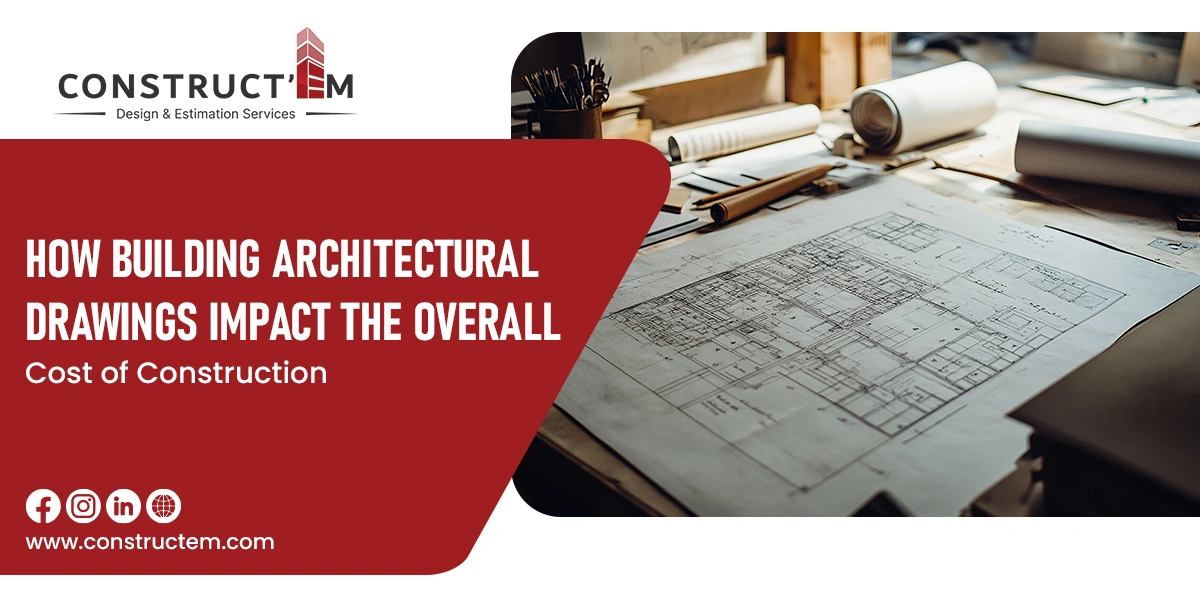
For most experienced contractors, keeping a construction project on budget always comes down to one thing: effective planning. Not just rough sketches or a quick floor layout, but detailed Building Architectural Drawing sets that show exactly how the structure will come together.
Architectural drawings have far more impact than just the appearance of the building. Architectural drawings guide how contractors order materials, coordinate crews, and estimate project costs. For contractors, working with professional architectural drawing services often means the drawings themselves become the backbone of project budgeting. Architectural drawings and insights from construction cost estimating experts turn a design concept into a practical financial plan. Without detailed drawings and cost planning, projects often drift into costly territory. Let’s have a look into it.
At first glance, a drawing may seem like a visual representation of the building but in reality, it functions more like a technical instruction manual for the entire project.
A proper architectural drawing show:
Every trade involved in the project relies on the details listed above to plan their work efficiently and avoid costly mistakes.
Trying to estimate construction costs without detailed drawings is like planning a puzzle without seeing the pieces. Eventually you’ll discover things don’t fit as expected.
Clear drawings allow estimators to measure:
From there, labor hours and material quantities become easier to calculate.
Professional construction cost estimating experts heavily rely on drawings because they remove uncertainty. The more accurate the drawings are, the more accurate the estimate becomes.
That alone can prevent major budget surprises later.
Material waste is one of the factors that can cause cost while construction. A project without proper drawings may order far more materials than necessary just to stay safe. Commercial construction estimating experts improve their quantity estimation abilities which helps in purchasing materials with greater accuracy. The installation of drywall requires precise measurements of wall dimensions because it serves as the foundation for all installation work.
Construction sites involve multiple crews working within the same physical space. Electricians, plumbers, HVAC technicians, framers, and drywall installers often operate within inches of each other’s work. Without coordinated drawings, conflicts happen. A duct may interfere with a beam. A pipe may run through a planned electrical path. Fixing these conflicts on site means tearing out completed work and starting again.
That kind of rework is expensive. Detailed architectural plans help identify these issues before construction begins. This allows teams to adjust the design early, when changes cost far less.
Local authorities typically require full architectural drawings before issuing building permits. The use of incomplete plans together with vague plans leads to project delays because officials require project changes. The construction process experiences rapid delays because of this issue. Construction teams may already have workers scheduled equipment rented or materials ordered. The project schedule experiences a delay of one week because of the need to wait for corrected drawings.
Architectural drawing services for contractors help their projects avoid delays. Their plans are prepared with building regulations in mind which makes the approval process smoother. Faster approvals enable construction to commence earlier while maintaining project timelines.
Once a design is clearly documented, project teams can review it for cost-saving opportunities.
This process is often called value engineering. It involves finding smarter ways to achieve the same result without sacrificing quality.
Examples might include:
These improvements are difficult to identify without detailed drawings. When the entire project is mapped out visually, those opportunities become easier to spot.
The situation occurs at least once for most contractors, when the project begins with incomplete drawings. The construction team begins to install framing; electrical installers start their wiring work and plumbers installing the piping. The team discovers that two systems are using the same wall space. The workers need to take out existing work to create new construction.
The issue requires one or two days to fix the problem while it creates extra expenses that prevent other workers from doing their jobs and it eventually results in material waste. The small issue creates larger problems when it happens in bigger projects. The construction process gets eliminated from multiple problems when architects produce detailed architectural drawings.
Even with strong architectural plans, construction costs fluctuate due to market conditions, labor availability, and material pricing.
This is where constructem provide valuable insight. They analyze drawings and combine them with real pricing data to produce accurate projections.
Their work helps contractors:
When estimators and architects collaborate early, the financial side of construction becomes far more predictable.
Many project owners focus heavily on the visible parts of construction—the finishes, materials, and final design. But the planning phase quietly determines whether the project stays within budget.
Investing in quality architectural drawings may seem like an upfront cost. In reality, it often prevents far larger expenses during construction. Clear plans reduce confusion, minimize waste, and help teams build efficiently. In the long run, good drawings almost always pay for themselves.
The installation cost of drywall throughout the United States ranges between $1.50 and $3.50 per square foot because the price includes both labor and materials. The expenses for a project increase based on the height of the ceiling and the level of finishing work and the rates charged by local workers. Projects that require both special drywall types and complex designs typically reach their maximum cost limit.
The price of fire-rated drywall exceeds that of regular drywall because it includes extra material for fire protection. The price for installation work typically ranges between $1.60 and $3.50 for each square foot. The building code requires these boards to be installed in garage areas and stairwells and between residential spaces and their connected utility rooms.
Yes. The least expensive wall option which exists in the current market uses standard half-inch drywall. The material cost for basic drywall sheets falls between $0.40 and $0.50 per square foot. The remodeling process becomes more cost-effective through precise measurement combined with correct planning because it minimizes the need for extra materials.
The price of moisture-resistant drywall known as green board or purple board exceeds that of regular drywall. The standard panels have a price range of $0.40 to $0.50 per square foot while moisture-resistant panels cost between $0.55 and $0.75 per square foot. The products find primary application in bathrooms and basements and laundry rooms.
The installation cost for drywall in a 2,000-square-foot residence ranges between $8,000 and $30,000 because of the different finish requirements and labor charges and ceiling height specifications. The need for extra labor and materials in homes with complex room arrangements and tall ceilings results in higher overall expenses.






Social Links
© Construct'EM - 2026. All rights reserved.