


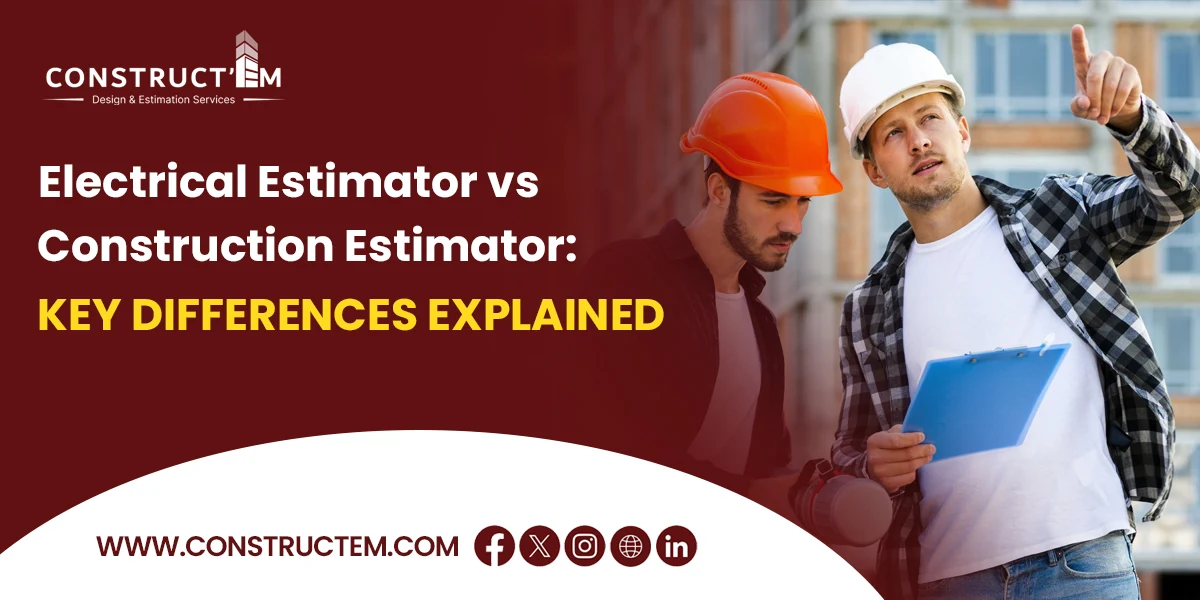
Figuring out costs forms the foundation of every building project. Guessing wrong puts your money at risk, causes holdups, or sparks fights about changing orders. This makes it crucial to know which type of estimator you need.
This article will compare an electrical estimator with a construction estimator. You’ll learn what each one does, how they’re different, and how to choose the right one. I’ll also add real stats and tips so it feels grounded, not just theory.
Estimates aren’t just numbers on paper; they set the foundation for your entire project. Consider this:
With so much money on the line, a small mistake in estimating can cost thousands of dollars. That’s why professionals, whether electrical or construction estimators, are essential.
An electrical estimator focuses on the electrical portion of a project. They calculate costs for wiring, lighting, circuits, panels, and controls. Eeverything that powers a building.
Because they specialize in one trade, electrical estimators dive deep into codes and technical standards. Their work ensures nothing is overlooked, keeping your project safe and on budget.
A construction estimator looks at the entire project. They manage costs for all trades — from foundation and framing to plumbing, HVAC, roofing, and yes, electrical work.
When you hire the best construction estimating company, you expect them to cover every detail — not just one section.
| Feature | Electrical Estimator | Construction Estimator |
| Scope | Electrical systems only | Entire project (all trades) |
| Depth | Very detailed on electrical parts | Broader view of all trades |
| Knowledge | Electrical codes, circuits, and power loads | Multiple trades, project management |
| Tools | Electrical estimating software | General construction estimating software |
| Impact | Influences only the electrical budget | Influences the total project profit and viability |
If your project only involves electrical work, an electrical estimator may be enough. For larger projects, a full construction estimator or the best construction estimating company is a safer bet.
Both types of estimators break a project into pieces and assign realistic costs. They just work at different levels.
In short, electrical estimators focus on one trade, while construction estimators handle the bigger picture. Both ensure projects stay on budget, just at different levels.
Choosing the wrong estimator can lead to:
For small electrical projects, a skilled electrical estimator may be enough. For larger builds, working with the best construction estimating company ensures accurate coverage for all trades and smoother execution.
When choosing an estimating company, look for:
Fun fact: In 2024, 51% of U.S. electrical contracting firms were small (1–9 employees), and 42% had revenue of $1 million or less. A top construction estimating company balances skill, experience, and technology to keep your project on track.
Know more about How a Metal Building Estimator Cut Project Costs by 25%
They analyze electrical plans, count materials, estimate labor, get quotes, and create a detailed electrical cost proposal.
Search locally, check portfolios, ask for sample estimates, read reviews, and make sure they handle both electrical and construction estimating.
Look for timeliness, clear proposals, responsiveness, positive testimonials, and modern tools.
Accuracy, transparency, experience, flexibility, and technical proficiency.
They break down materials, labor, overhead, and profit, using past data and safety margins to finalize costs.





Social Links
© Construct'EM - 2026. All rights reserved.