


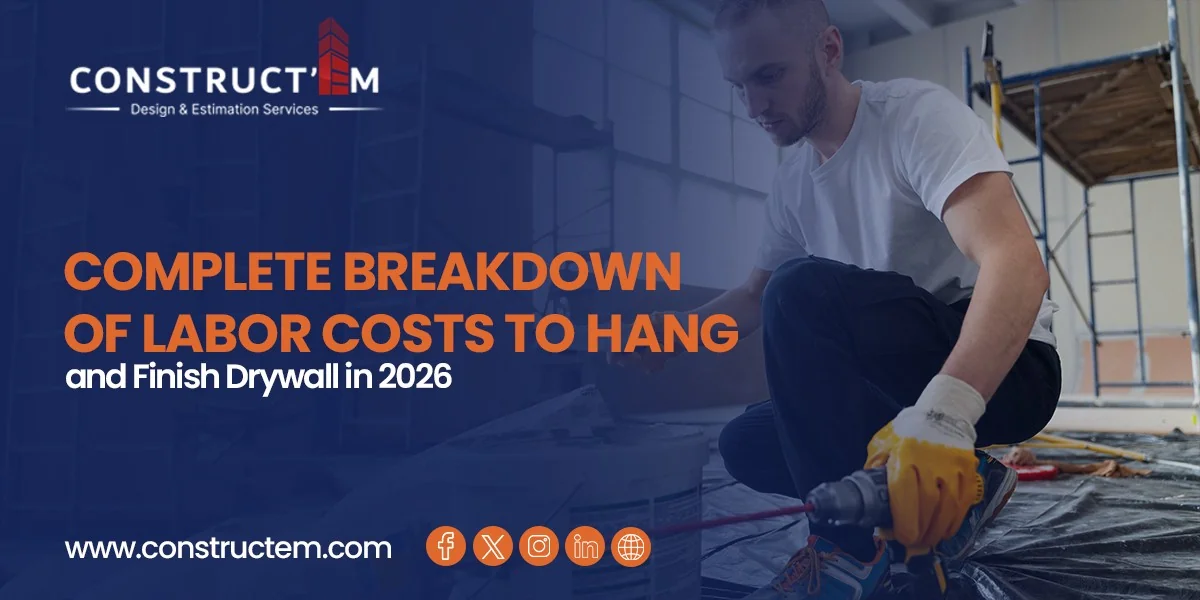
According to data from the U.S. Bureau of Labor Statistics (BLS), construction wages have increased by over 4.5% year-over-year, while skilled labor shortages continue to tighten the workforce. Among all interior trades, drywall installation and finishing stand out as one of the most labor-intensive and cost-sensitive processes.
That’s exactly why understanding the Labor costs to hang and finish drywall has become critical for contractors, builders, developers, and estimators. One small miscalculation can quickly snowball into budget overruns, scheduling delays, and profit loss.
This guide walks you through a complete, clear, and practical breakdown of drywall labor costs in 2026. We’ll explore real-world pricing, cost drivers, finish levels, estimating strategies, and how professional general contractor cost estimating and accurate drywall material takeoff can help you stay competitive and profitable.
Before discussing numbers, it’s important to understand what this process actually involves. Drywall installation isn’t just about putting sheets on walls. It’s a multi-step operation that requires skill, planning, and precision.
This is the physical installation stage, which includes:
This is where craftsmanship truly matters. It involves:
Finishing is the most time-consuming phase and often accounts for 60–70% of total drywall labor costs. The smoother and more flawless the required surface, the higher the labor input.
Drywall labor costs vary by region, project size, and complexity, but current industry data gives us reliable national averages.
Cost Per Square Foot Breakdown
| Scope of Work | Average Labor Cost (2026) |
| Hanging Only | $0.60 – $1.10 per sq ft |
| Finishing Only | $1.10 – $2.50 per sq ft |
| Hanging + Finishing | $1.75 – $3.75 per sq ft |
So, the average labor cost in 2026 typically falls between $1.75 and $3.75 per square foot.
These numbers show how quickly drywall labor can become a major budget item, especially on large projects.
Residential projects tend to stay on the lower side due to:
Commercial projects cost more due to:
Drywall finish levels play a massive role in labor pricing. Each level requires different amounts of time, skill, and attention to detail.
| Finish Level | Typical Application | Labor Cost Impact |
| Level 0–1 | Garages, storage rooms | Very Low |
| Level 2 | Warehouses, utility areas | Low |
| Level 3 | Textured finishes | Moderate |
| Level 4 | Residential interiors | High |
| Level 5 | Luxury & architectural spaces | Very High |
A Level 5 finish, commonly used in luxury homes, hospitals, corporate offices, and high-end commercial spaces, can increase labor costs by 30–60% due to extra skim coats, sanding, and precision finishing.
Drywall labor pricing isn’t fixed. Several variables shape the final number.
Large open spaces allow faster installation. Tight layouts, multiple corners, curved walls, and custom architectural features slow down productivity and increase labor hours.
Standard 8–9 ft ceilings are easy and quick. Tall ceilings, stairwells, vaulted spaces, and hard-to-reach areas require scaffolding, lifts, and more manpower.
Higher finish levels demand multiple coats, extended drying time, extra sanding, and skilled craftsmanship.
Urban markets and high-growth construction zones often experience labor shortages, driving wages higher.
Tight deadlines often require overtime or additional crew members, increasing labor rates by 15–30%.
For general contractors, drywall labor is one of the most unpredictable cost elements. That’s why accurate general contractor cost estimating plays a critical role in maintaining profitability.
Precise labor estimation helps:
Instead of relying on rough averages, professional estimators, including the team at ConstructEM, calculate:
This approach ensures realistic pricing and minimizes financial risk.
A detailed drywall material takeoff is the backbone of precise labor estimating.
When material quantities are inaccurate:
Accurate takeoff ensures:
Simply put, accurate material takeoff directly improves labor efficiency and cost control.
Even experienced contractors fall into these costly traps:
Labor rates change rapidly. Old pricing models lead to severe underestimation.
Many estimates fail to account for the labor jump from Level 4 to Level 5 finishes.
Prep work, site movement, and cleanup all consume paid labor hours.
Without labor contingency buffers, unexpected delays quickly damage budgets.
Professional estimating services help contractors:
By combining general contractor cost estimating with accurate drywall material takeoff, contractors gain full visibility into labor, material, and project timelines — allowing smarter decisions from pre-bid to project closeout.
In 2026, drywall labor is no longer just another line item — it’s a strategic cost factor that directly impacts project success.
Understanding the true labor cost to hang and finish drywall, knowing what drives pricing, and using professional estimating methods can mean the difference between profitable projects and costly overruns.
That’s why teams at ConstructEM focus on data-driven estimating and detailed takeoffs to help contractors plan smarter, build faster, and stay profitable.
Contractors typically charge between $1.75 and $3.75 per square foot, depending on project size, complexity, and finish level.
Drywall finishers usually charge $1.10 to $2.50 per square foot, based on finish quality, surface preparation, and sanding requirements.
Most residential drywall projects take two to five days, depending on square footage, finish level, drying time, and crew size.
Labor costs depend mainly on finish level, ceiling height, layout complexity, project urgency, and local labor market conditions.
Yes, commercial drywall labor costs more due to higher ceilings, stricter finish standards, safety requirements, and complex structural layouts.



Social Links
© Construct'EM - 2026. All rights reserved.