We’ve all been there, sitting at a desk late into the evening, eyes straining over a set of blueprints while clicking frantically through a sprawling Excel spreadsheet. Estimating plumbing jobs manually is a rite of passage in the construction world, but it is also one of the easiest ways to accidentally eat into your profit margins. According to the National Cooperative Highway Research Program, estimation errors alone account for 32% of construction cost overruns.
For plumbing contractors and growing construction teams, figuring out whether to stick with in-house spreadsheet math or outsource to professional plumbing estimating services comes down to one simple question: Can your budget afford a mistake?
The Real-World Mess of Manual Plumbing Takeoffs
Let’s be honest about what a manual takeoff actually looks like on a busy Tuesday afternoon. You have physical highlighters, digital PDF markers, and a coffee mug that’s long since gone cold.
The Fatigue Factor and Human Error
- Mental Fatigue: When you are manually counting every single fixture, elbow joint, and linear foot of pipe across a multi-story commercial drawing, mental exhaustion sets in quickly.
- Deadline Pressures: Even the most seasoned estimators miss critical details when working under tight bidding timelines.
- Formula Disasters: A single misplaced decimal point or a broken formula in row 400 can easily cascade into thousands of dollars in unbudgeted out-of-pocket expenses once work begins on-site.
The Parts We Always Forget to Count
It is rarely the main sewer stack or the primary water supply line that wrecks an estimate. It is the small, high-frequency hardware items that estimators accidentally gloss over, including:
- Hangers, vertical supports, and seismic bracing brackets
- Specialized transition couplings, adapters, and P-traps
- Joint compounds, flux, hanger strapping, and support valves
- Localized municipal permit, testing, and inspection fees
When these items aren’t factored into the bid, your field crew still needs them to finish the job, which means your business absorbs the unexpected cost.
Stop Losing Profit to Estimating Errors
Manual plumbing estimates can lead to costly mistakes, missed materials, and inaccurate labor calculations. Get precise, data-driven plumbing estimating services from ConstructEM and submit competitive bids with confidence
Get Your Plumbing Estimate
Why Static Pricing Destroys Bids in Dynamic Markets
Another major headache with manual spreadsheets is that they rely on static, memorized, or outdated pricing.
Chasing a Moving Target
- Quarterly Shifts: Construction material costs do not sit still. Common infrastructure inputs—such as copper tubing, PVC fittings, cast-iron stacks, and specialized mechanical insulation estimating materials, shift in price constantly based on broader supply chain fluctuations.
- Outdated Baselines: If you build an estimate today using material prices you pulled off a supplier’s website six months ago, your bid is already wrong before you even hit send.
- Live Integration: Professional estimating teams avoid this trap by plugging directly into live, regional supplier databases that update in real-time.
The Hidden Impact of Labor Burden and Productivity Rates
Materials are only half of the equation when calculating a profitable plumbing bid. The other half is labor, and that is where manual estimates most frequently fall apart.
- The Flat-Rate Trap: When contractors build spreadsheets by hand, they often rely on a generic, flat-rate hourly wage for every plumber on the job, completely ignoring the reality of modern job sites.
- The True Labor Burden: A proper calculation must account for payroll taxes, workers’ compensation, insurance, and benefits alongside crew productivity rates.
- Site Realities: Stringent multi-story buildings present vertical transport challenges, tight mechanical rooms create spatial bottlenecks, and local wage variations can swing labor costs by 20% to 40%. Professional estimators build these complex variables into their models.
Technology Integration: How Digital Takeoff Tools Transform Accuracy
The big dramatic gap in accuracy between manual spreadsheets and professional estimating really comes down to this technological firepower thing, like it or not.
- Advanced Tooling: While manual workflows rely on paper plans and scale rulers, professional estimating firms use advanced digital takeoff and modeling suites.
- Automated Extraction: Specialized MEP software, digital vectorization apps, and automated counting algorithms let estimators upload entire stacks of CAD or PDF drawings, then pull out the exact linear footage, pipe diameters, and fitting counts, pretty much automatically.
- Near-Zero Error: This reduces scale-conversion mistakes, and it also helps ensure those secondary runs never get skipped, even by accident. And once digital precision is paired with the trained eye of an experienced MEP estimator, the space for human error shrinks a lot.
How Professional Services Bring Clarity and Control
When you partner with a dedicated estimating firm, especially when looking for the Best Construction estimation in USA, you aren’t just paying someone to count pipes. You are buying structural precision and risk mitigation.
Real-World Experience: The Multi-Family Nightmare
- The Manual Route: A mid-sized mechanical contractor spent three rushed days counting bathrooms and kitchen stacks for a 50-unit apartment building. Because they were running out of time, they threw in a rough percentage guess for below-grade fittings. Once trenching started, they realized they missed 14% of the drainage fittings, a $12,000 surprise bill that wiped out their expected earnings.
- The Professional Route: When that same company later partnered with an experienced provider of plumbing estimating services, the team utilized digital grid cross-referencing and fixture schedule validation. They caught every slope requirement and unique transition cleanly. The bid won the contract, and the project wrapped up within 2% of the initial estimate.

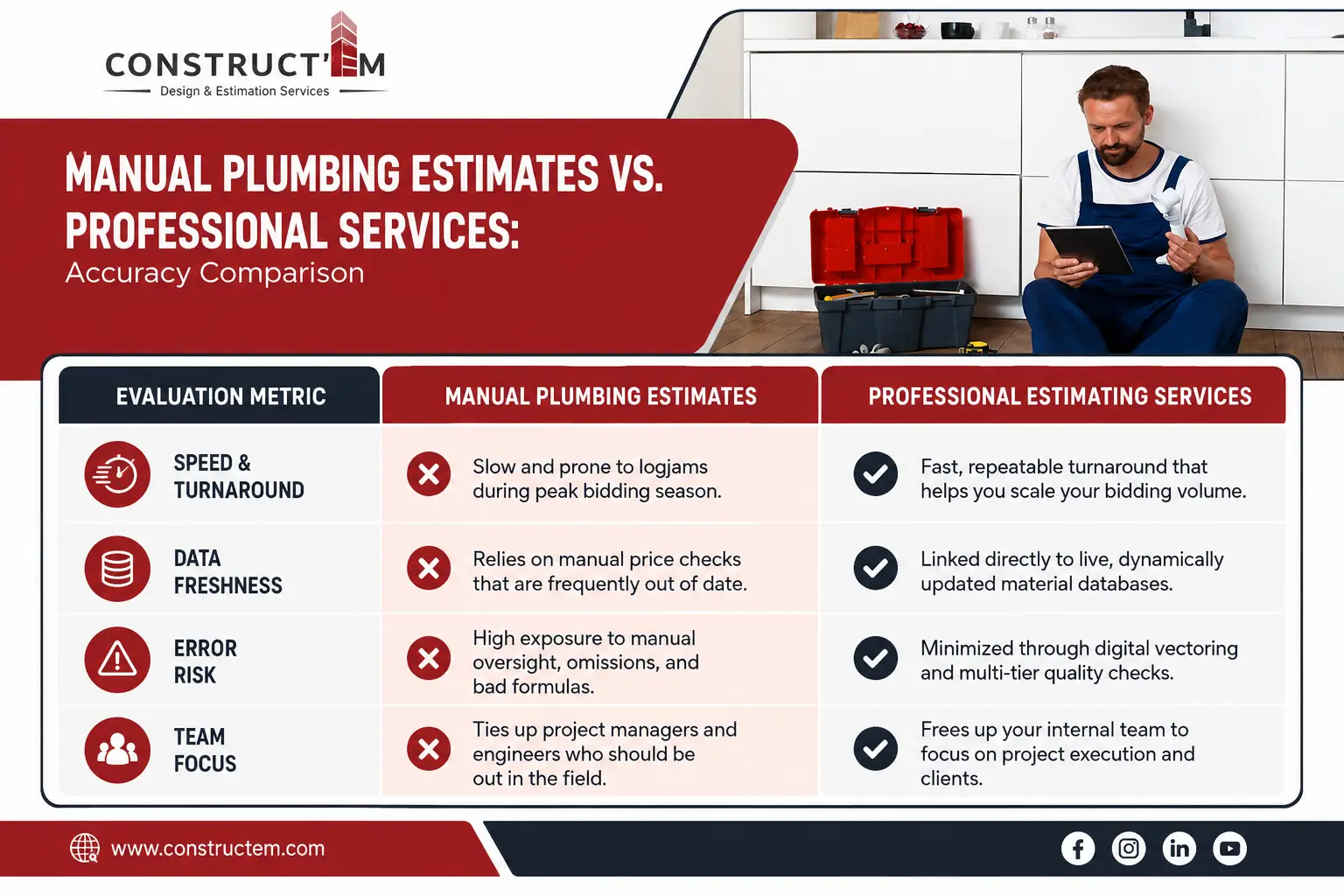
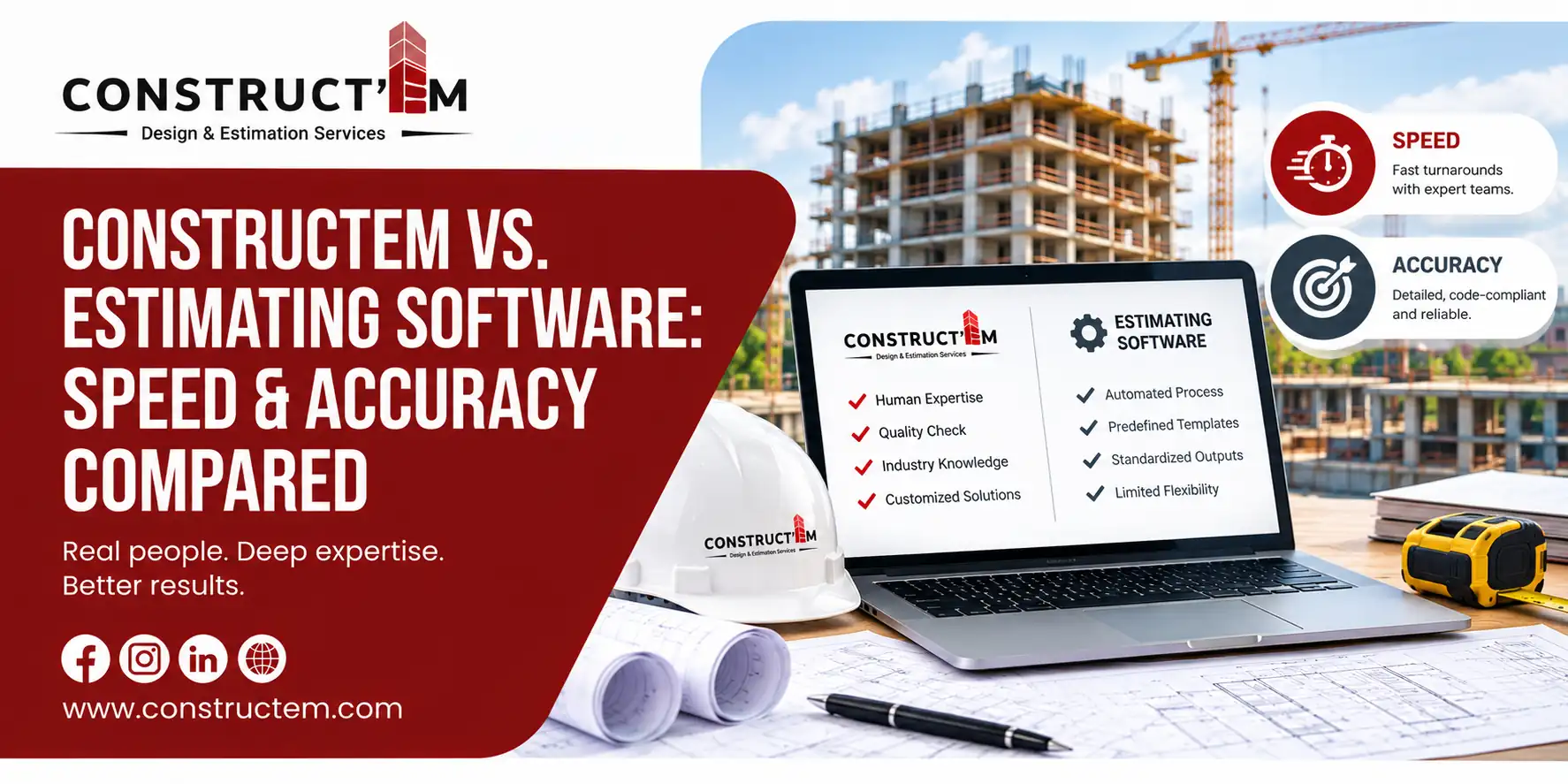
Side-by-Side: Manual Workflows vs. Professional Services
| Evaluation Metric | Manual Plumbing Estimates | Professional Estimating Services |
| Speed & Turnaround | Slow and prone to logjams during peak bidding season. | Fast, repeatable turnaround that helps you scale your bidding volume. |
| Data Freshness | Relies on manual price checks that are frequently out of date. | Linked directly to live, dynamically updated material databases. |
| Error Risk | High exposure to manual oversight, omissions, and bad formulas. | Minimized through digital vectoring and multi-tier quality checks. |
| Team Focus | Ties up project managers and engineers who should be out in the field. | Frees up your internal team to focus on project execution and clients. |
Making the Call for Your Contracting Business
- Shift in Perspective: Walking away from manual spreadsheet stuff isn’t really about giving up; it’s more like a smart business move you do on purpose.
- Confidence in Numbers: When your bids rely on actual data, cleaner takeoffs, and pricing that’s consistent, you don’t keep re-checking everything in your head.
- Long-Term Solvency: Good estimates create a firmer kind of trust with general contractors, reduce the annoying change-order fights, and keep your cash flow steady. Besides, if you use plumbing estimating services that are dedicated, you safeguard your bottom line from the very first day.
Conclusion
At the end of the day, accurate plumbing estimates form the backbone of a profitable construction business. While traditional spreadsheets and manual highlighters feel familiar, they leave far too much room for human error and shifting market prices. By teaming up with expert estimators like Constructem who leverage modern digital tools and real-time market data, you can bid with confidence, protect your profit margins, and grow your business sustainably.
Know more About Insulation Takeoff vs. Cost Estimate: What’s the Difference?
Frequently Asked Questions (FAQs)
How does New Construction Plumbing Estimating differ from Renovation Plumbing Estimates?
New builds feature clean blueprints and straightforward layouts, whereas renovations require messy field verifications, hazard checks, and tricky tie-ins to old legacy piping.
What is involved in Multifamily Plumbing Estimating and apartment building takeoffs?
Multifamily projects demand careful vertical stacking analyses and repetitive fixture counts to keep budgets tight across dozens of identical units.
How does Plumbing Estimating with Value Engineering create cost-saving strategies?
Value engineering looks at alternative materials, smarter pipe routing, and clever design tweaks to lower overall costs without sacrificing code compliance or quality.
How accurate are professional plumbing estimating services?
Professional estimating teams are remarkably precise, typically landing within a very tight 1% to 3% margin of actual final project execution costs.
What makes a construction estimating company the “best”?
The top agencies combine advanced takeoff software, up-to-date regional labor pricing, certified MEP industry experience, and strict multi-tier quality reviews.
How much do plumbing estimating services cost?
Pricing usually depends on project size and complexity, structured either as a flat project fee, an hourly consulting rate, or a percentage of the total build cost.
How much does a residential plumbing estimate cost?
Residential estimates generally run from a few hundred to over a thousand dollars, depending entirely on home square footage and fixture count complexity.