


In the construction industry, accuracy is the currency of success. Whether you are a general contractor, a building owner, or an insulation specialist, you likely hear the terms “takeoff” and “estimate” used almost interchangeably. However, in the world of professional building services, treating these two concepts as the same thing is a recipe for budget overruns, material shortages, and profit loss.
Therefore, for those looking to streamline this, many firms now rely on professional insulation takeoff services to ensure accuracy from day one. Here is a deep dive into the difference between an insulation takeoff and a cost estimate.
To understand the difference, we must first look at what each process actually achieves.
An insulation takeoff is a purely quantitative process. It involves a systematic breakdown of every piece of material required to complete the insulation portion of a project. During a takeoff, the estimator or contractor reviews the blueprints, architectural plans, and specifications to take off the measurements. Therefore, as the industry evolves, the demand for reliable construction cost takeoff services in USA infrastructure projects has surged
The result of a takeoff is a Bill of Materials (BOM). It tells you how much you need, not how much it will cost. For example, an insulation takeoff will tell you that you need 4,500 square feet of R-30 fiberglass batt insulation, 15 rolls of vapor barrier tape, and 200 boxes of staples.
An insulation cost estimate is a financial projection. It takes the quantitative data from your takeoff and applies market-driven pricing to it. A cost estimate is not just about the material; it encompasses the total investment required to get that material installed in the building.
The result of a cost estimate is a Project Bid or Budget. It shows the total project cost, including material costs, labor hours, equipment rentals, overhead, and profit margins.
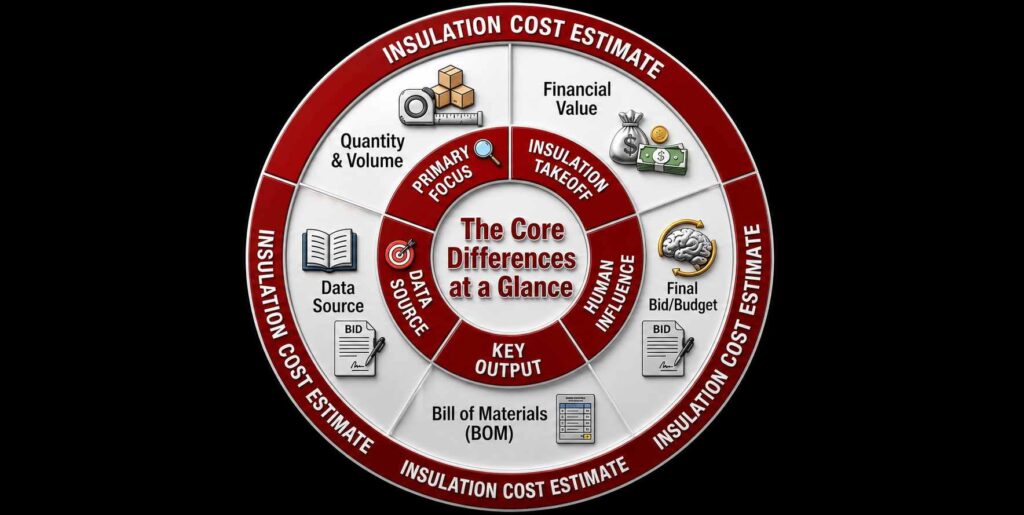
| Feature | Insulation Takeoff | Insulation Cost Estimate |
| Primary Focus | Quantity & Volume | Financial Value |
| Data Source | Blueprints & Specs | Takeoff Data + Market Rates |
| Key Output | Bill of Materials (BOM) | Final Bid/Budget |
| Human Influence | Mathematical accuracy | Strategic decision-making |
| Objective | Defining scope | Defining profitability |
Let our expert estimators deliver fast, accurate bids for you.
Get up to 30% Off your first quote
Think of the takeoff as the bedrock of your construction project. If your takeoff is flawed, your estimate, no matter how sophisticated your accounting software, will be inherently wrong.
If you underestimate your material needs during the takeoff phase, you are looking at two major problems: supply chain delays (waiting for an extra truckload to arrive) and increased shipping costs. Conversely, if you overestimate, you end up with expensive inventory sitting in your warehouse, tying up your cash flow.
When managing a complex project, the most successful firms outsource to construction cost takeoff services in USA to ensure local labor rates and regional market fluctuations are factored in. Consequently, working with the best construction estimation company provides you with more than just numbers; it gives you the business intelligence to scale your operations.
Many estimators fall into the trap of using a “one-size-fits-all” labor rate. What differentiates the best construction estimation company from the rest is their ability to accurately factor in site-specific labor productivity adjustments.
To create an accurate estimate, you must apply Productivity Factors:
The cost estimate manages risk through contingency and market strategy. While the takeoff is concerned with what is on the blueprints, the estimate is concerned with what might be behind the walls. It builds in a Contingency Buffer, a financial cushion, typically 5–10% of the total bid, to protect your profit margins against the unknown. However, the best construction estimation company will ensure your contingency buffers are based on data, not just guesswork, effectively protecting your profit margins.
Know more about Should I Use Software or Hire Construction Cost Takeoff Services?
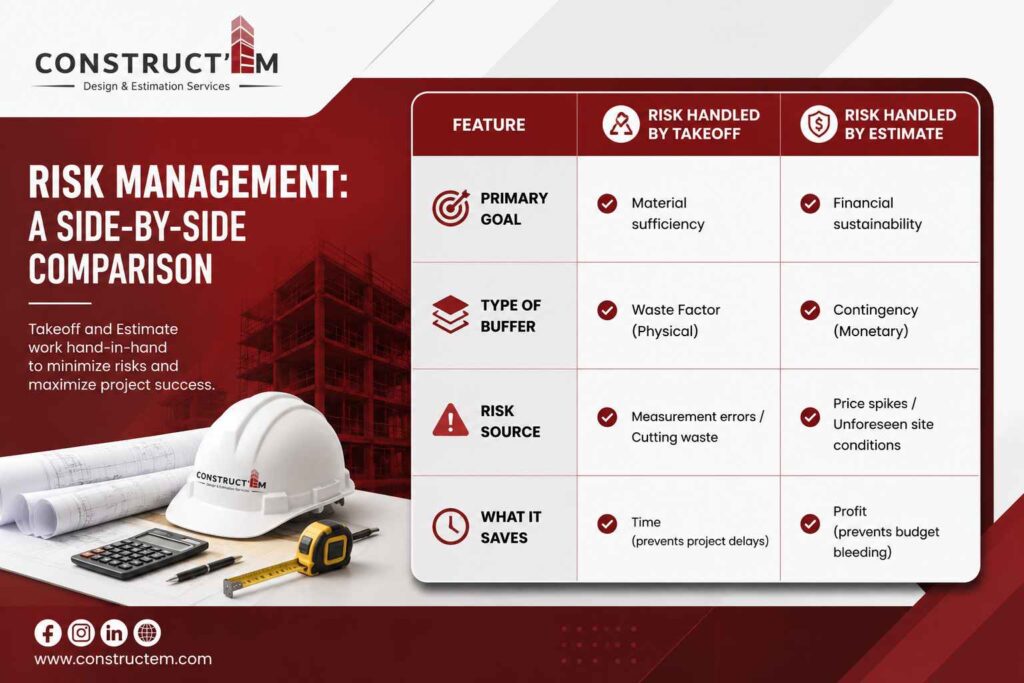
| Feature | Risk Handled by Takeoff | Risk Handled by Estimate |
| Primary Goal | Material sufficiency | Financial sustainability |
| Type of Buffer | Waste Factor (Physical) | Contingency (Monetary) |
| Risk Source | Measurement errors / Cutting waste | Price spikes / Unforeseen site conditions |
| What it Saves | Time (prevents project delays) | Profit (prevents budget bleeding) |
In today’s market, top-tier construction cost takeoff services in USA maintain databases of real-time material pricing to protect your bid from volatility. A takeoff performed three months ago might be based on pricing that no longer exists.
There is a major difference between a Budgetary Estimate and a Hard Bid:
Essential Rule: Always look at the expiration date on your supplier’s quote. If your estimate relies on a quote that expired two weeks ago, your “cost” is now a guess. Always include a clause in your proposal that states your price is valid for a specific timeframe (e.g., 15 or 30 days). This forces the client to move forward with a decision, protecting you from being locked into a contract where your material costs have suddenly surged by 15% due to a market shift.
In the past, estimators relied on scale rulers, highlighters, and spreadsheets. Today, digital takeoff software has revolutionized the field. Tools like Bluebeam, Planswift, or specialized insulation software allow for “point-and-click” measurements.
While digital tools are powerful, the value of insulation takeoff services lies in the human expertise applied to these tools, catching errors that software might miss. Therefore, modern construction cost takeoff services in USA integrate advanced digital tools to turn around bids faster than manual methods ever could
Before you hit “send” on that estimate, perform a final audit. Even the best estimators can miss a decimal point or forget a secondary cost. Ultimately, high-quality insulation takeoff services serve as the blueprint for your profitability. Run your document through this quick checklist:
By adopting the best practices utilized by construction cost takeoff services in USA, you ensure your firm remains ahead of the curve.
You cannot have a reliable bid without both. If you only provide a takeoff, you aren’t running a business; you are just providing a shopping list. If you only provide an estimate without a transparent takeoff, your clients won’t trust your numbers.
Choosing the best construction estimation company for your project is an investment in your company’s long-term growth and stability. Whether you handle it internally or leverage external insulation takeoff services, your goal should always be a precise Bill of Materials. The takeoff is for the materials, and the estimate is for the money. Mastering the distinction allows you to bid more competitively, manage your projects more efficiently, and protect your margins in an ever-changing construction landscape.







Social Links
days day
hours hour
minutes minute
seconds second
Lock in Flat 30% off before your quote reservation expires.
Precision material takeoffs & cost estimates delivered fast for USA Contractors.