

It always starts small. A tiny leak, a quick pipe fix, a simple bathroom upgrade. But somehow, the bill always ends up bigger than expected.
That’s because plumbing costs are often underestimated. Hidden piping, labor gaps, and fast-changing material prices can quietly push projects beyond budget. This is where a plumbing cost estimator quietly becomes the difference between a smooth project and a financial mess.
In this guide, we’ll break down how accurate plumbing estimates prevent budget overruns, streamline the plumbing estimating process, and bring real cost clarity to projects of every size.
A plumbing cost estimator is not just someone who plugs numbers into a spreadsheet. Their job is to translate blueprints, site conditions, and market data into a detailed, reliable budget.
Specifically, they:
In short, the estimator is the budget safety net. without it, projects are flying blind.
Even seasoned contractors can be caught off guard. According to the Construction Industry Institute (CII), poor cost estimation accounts for up to 70% of project overruns, and large construction projects exceed budgets by an average of 30%.
The main culprits?
Without a structured estimate, each of these factors quietly pushes the budget higher. That’s exactly why professional estimation matters. it doesn’t just predict costs; it prevents them from spiralin
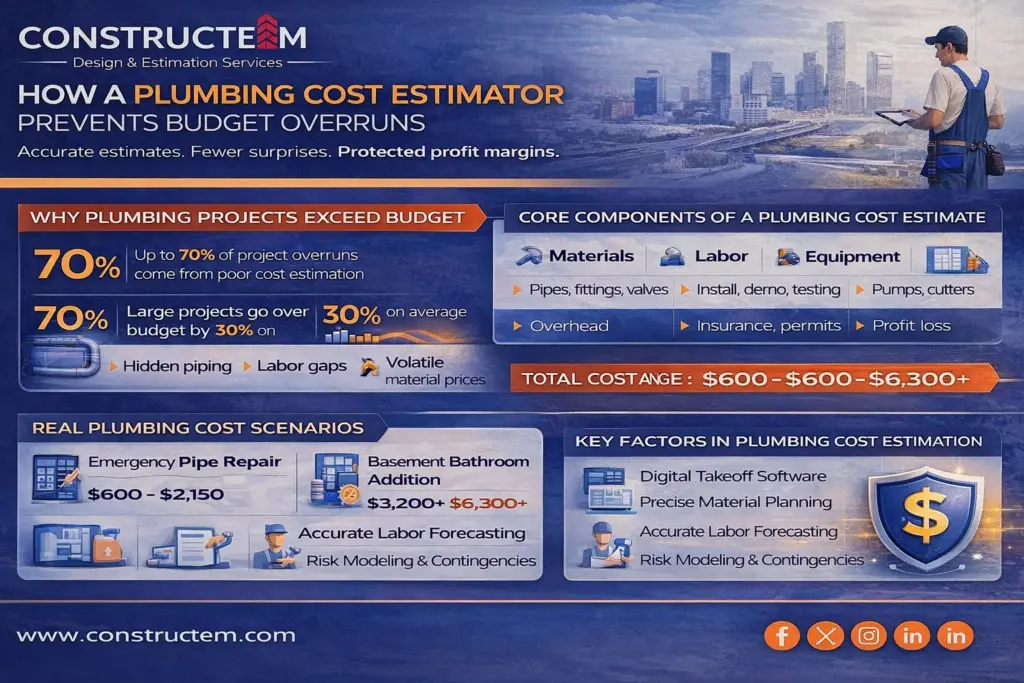
To understand how estimators prevent overruns, it’s important to see what they calculate. Missing even one element can quickly inflate costs.
| Cost Component | Description | Risk if Missed |
| Material Takeoffs | Pipes, fittings, valves, fixtures | Overbuying or shortages |
| Labor Costs | Installation, demolition, testing | Understaffing or overtime |
| Equipment & Tools | Pumps, cutters, lifts | Delays or rental cost spikes |
| Fixtures & Appliances | Sinks, toilets, showers, heaters | Reorders or substitutions |
| Overhead & Profit | Admin, insurance, permits | Loss of margin |
| Contingency | Unexpected repairs or complications | Budget surprises |
For example, consider fixing a burst pipe. Without a detailed estimate, labor and material costs can quickly double. An estimator anticipates these components, so costs are transparent and controlled.
Here’s where the story gets practical: estimators don’t just calculate but prevent financial surprises.
Natural internal link placement: Contractors working on smaller projects can also benefit from Affordable Plumbing Quotations for Small Renovation Projects to avoid surprise costs.
Modern plumbing estimators don’t rely solely on experience. Software and digital tools amplify accuracy:
According to Autodesk’s 2024 Construction Technology Report, contractors using digital estimating tools reduce cost overruns by up to 20% and improve bid accuracy by over 30%.
By combining technology with expertise, estimators prevent the guesswork that causes overruns.
| Cost Component | Estimated Range (USD) |
| Emergency Labor | $150 – $400 |
| Pipe Materials | $50 – $250 |
| Drywall & Surface Repair | $200 – $700 |
| Leak Detection & Testing | $100 – $300 |
| Cleanup & Restoration | $100 – $500 |
| Total Estimated Cost | $600 – $2,150 |
In both cases, having a detailed estimate prevents surprises and keeps the project within budget, even when unforeseen issues arise.
Professional contractors don’t just want estimates. They want accuracy, speed, and reliability.
Trusted
construction estimating services for contractors provide:
Companies like ConstructEM deliver reliable plumbing estimates for commercial and residential projects, helping contractors focus on execution rather than firefighting finances.
The next time a simple plumbing task seems “easy,” remember, the hidden costs are always lurking. A plumbing cost estimator catches them before they appear on the invoice.
From commercial builds to emergency repairs and basement bathroom additions, a good estimate provides clarity, confidence, and protection. Because in construction, the smartest investment is knowing exactly what your project will cost before the first drop of water flows.
Plumbing a 2,000 sq ft house typically costs $8,000–$20,000, depending on labor, materials, fixtures, and complexity of the plumbing system.
Plumbers consider labor, materials, fixture quality, project complexity, accessibility, permits, and regional market rates to calculate pricing accurately.
Standard quotes include materials, labor, permits, and contingency costs. Paying a small fee is normal, especially for detailed, site-specific estimates.
The 30% rule suggests renovating only up to 30% of a home’s value to avoid overspending or negatively affecting resale value.
The structure, foundation, and labor-intensive systems like plumbing, electrical, and roofing usually account for the highest costs in new construction.



Social Links
© Construct'EM - 2026. All rights reserved.