


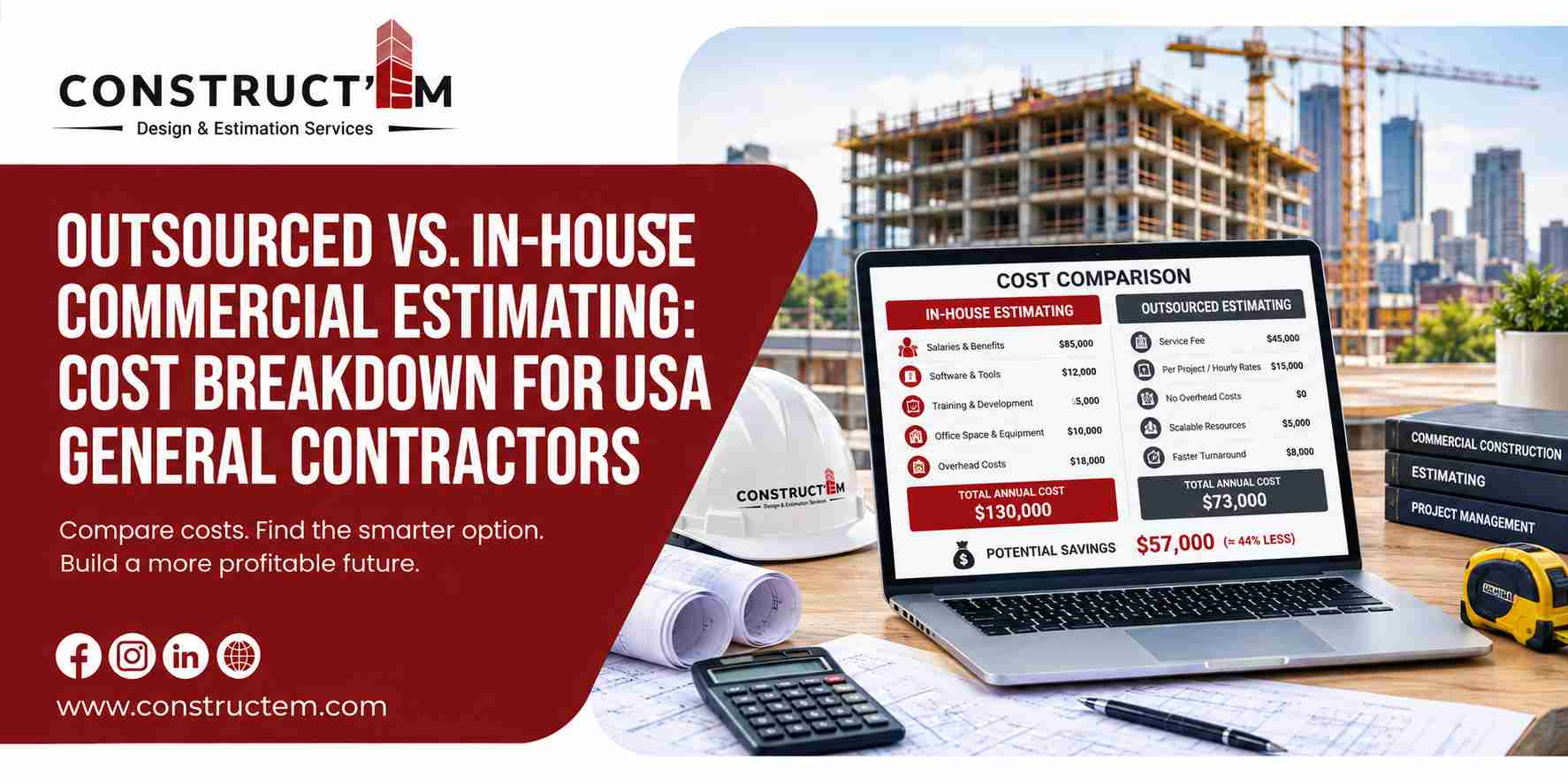
For US general contractors, winning work requires sharp pricing, but putting together estimates takes an immense amount of time and technical labor. When evaluating this critical function, many contractors make the mistake of looking strictly at an estimator’s salary and assuming that represents the total cost.
In reality, the financial footprint goes far beyond base pay. Factor in specialized software, ongoing training, employee benefits, workstation hardware, overhead, and missed bid opportunities due to workload fluctuations, and the true cost scales up rapidly. Weighing these expenses against outsourcing leads many firms to explore professional Commercial Estimating Services
Maintaining a fully functioning estimating department requires managing several distinct cost layers. Understanding the true financial impact means breaking down these expenses piece by piece.
According to data from the US Bureau of Labor Statistics (BLS), the median annual wage for cost estimators is about $78,740, while specialized commercial construction estimators often earn average national salaries ranging from $85,000 to over $92,000. However, base pay is only the starting point. General contractors must also account for:
Modern commercial estimating cannot be done with a scale ruler and a paper blueprint. Maintaining a competitive edge requires heavy software investments, including:
Running an internal team also introduces structural overhead that must be distributed across every bid package. These less obvious expenses include physical office space, administrative support, management oversight time, professional development, and liability insurance. Ultimately, just because an internal estimator earns a specific annual salary does not mean that figure represents your total estimating expenditure.
Building an internal estimating department profoundly changes a contractor’s fixed overhead structure.
An in-house team remains a viable strategy under specific business conditions. Large commercial contractors with a massive, highly consistent volume of bids, deeply established workflows, and recurring project types benefit from keeping talent in-house. When a firm has the steady workload required to keep estimators fully utilized 40 hours a week, year-round, the fixed-cost model makes financial sense.
Conversely, the model strains profitability during market shifts. Paying full-time salaries during slow bid periods drains capital when fewer projects are out to tender. During peak seasons, those same estimators face crushing overtime or bottlenecks. Recruiting experienced talent is notoriously difficult, and staff turnover forces contractors to absorb the high cost of retraining new hires while managing severe capacity limitations when multiple major bids arrive simultaneously.
When an internal team is overloaded, the opportunity cost multiplies quietly behind the scenes. Stretched thin, estimators submit fewer total bids, cut corners on detailed quantity takeoffs, miscalculate material scopes, or lack the bandwidth to build a strong value-engineering strategy. Each rushed proposal or missed deadline directly reduces overall market competitiveness.
Shifting from an employee-based model to an outsourced, project-based model changes how general contractors account for estimating expenses.
Professional estimating firms generally steer away from a single universal dollar figure because project complexity, trade scope, and blueprint density vary dramatically. Instead, common pricing structures include:
When outsourcing, contractors aren’t just paying for a spreadsheet of numbers; they are purchasing ready-to-use capacity and institutional expertise. This value includes access to senior-level estimators, advanced digital takeoff software suites, constantly updated regional material and labor pricing databases, and meticulous scope reviews. Forward-thinking contractors often partner with established providers like Constructem USA Construction Estimating to secure reliable, bid-ready documentation without expanding their permanent headcount.
Let our expert estimators deliver fast, accurate bids for you.
Get up to 30% Off your first quote
To fully understand the financial implications, it helps to view the structural differences side by side.
| Cost Factor | In-House | Outsourced |
| Salaries | Fixed recurring cost | Project-based |
| Benefits & payroll | Contractor responsibility | Generally included in provider pricing |
| Software | Contractor pays | Often included |
| Training | Contractor pays | Provider-managed |
| Office/IT overhead | Required | Minimal/no additional cost |
| Bid capacity | Limited by staff | Can scale with workload |
| Slow periods | Employees remain on payroll | Pay when work is needed |
| High-volume periods | Overtime/new hires | Additional capacity available |
| Turnaround | Depends on internal workload | Agreed project timeline |
| Scalability | Slower | Easier to scale |
Looking beyond the table, the financial distinction becomes clear: in-house operations lock a company into fixed overhead that must be paid regardless of market cycles. Outsourcing transforms a fixed overhead liability into a variable, project-level expense that scales directly with revenue-generating activity.
Beyond the direct math on a balance sheet, outsourcing alters a general contractor’s operational capacity and growth potential.
Surges in the construction market demand agility. With an outside team, you can juggle several bids at once in peak season. You avoid the usual hiring rush and the training delay. That means you can aim for strong growth goals. You can lift your bidding numbers without having to grow your office right away.
Bid more while keeping your numbers right. When internal staff get extra support, they do not have to sprint through plan sets before the clock runs out. They can slow down just enough to check subcontractor quotes. They can confirm line items. Then they can send proposals that hold onto the margin you planned for.
Commercial construction requires granular precision across distinct scopes of work. Partnering with external experts gives contractors on-demand access to insulation material takeoff services USA, complex plumbing takeoffs, electrical breakdowns, concrete and structural calculations, and finish schedules. Utilizing specialized support such as an experienced plumbing estimation company in USA ensures that mechanical and specialty trade numbers are airtight.
An estimate is only as good as its final margin protection. A cheap estimate that misses major scope items is far more expensive than no estimate at all.
A single overlooked detail during the takeoff phase can ripple into massive financial losses downstream. Common slips show up as:
When these problems slip through, they often lead to nasty change-order fights, schedule delays, and thinner margins later on.
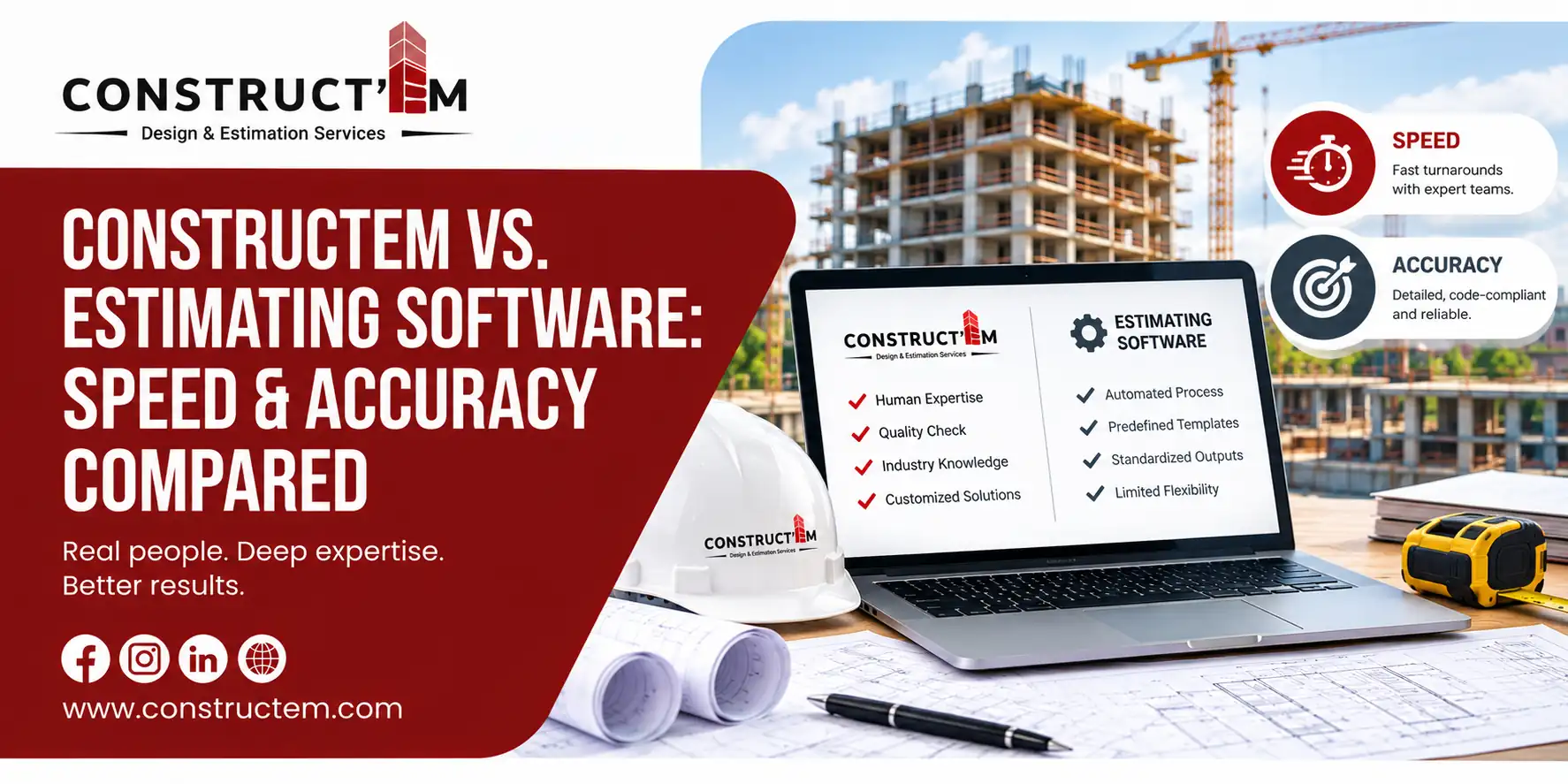
More accuracy is tied to the process, not just the number of people. Adding more internal estimators does not by itself fix the issue. You still need repeatable workflows, solid checks for quality, and pricing data that stays current. When general contractors evaluate external providers based on experience, reputation, and strict quality assurance protocols, qualities often found among the Top Construction cost estimating services in USA they insulate their businesses from costly bidding errors.
Determining the right model requires an honest internal audit of your current operations.
Commercial estimating is basically a math problem, not just a pricing exercise. You have costs that do not change much, and then you have the market, which never stays steady. In-house teams can work well when bids come in at a steady pace. However, software fees, benefits, and limits on staff can erode profit in quiet ways.
Outsourcing can help you move faster when demand spikes. You can take on more work during busy months. You can also keep your margins in check without adding headcount. When you bring in a partner such as Constructem Construction Estimating, estimating capacity stops feeling like a ceiling and starts acting like a tool you can use.
Know more about Which Insulation Takeoff Service Should I Use for a Large-Scale Residential Building?
Before you choose a provider, check for real client references. Also confirm they know US regional building rules. Ask about turnaround times of about 24 to 48 hours. Make sure they have solid work across common CSI categories.
Plans get reviewed to count materials, estimate labor time, and assign equipment costs. Results come as itemized numbers. This supports bids that stay competitive and profitable.
They provide on-demand scalability, eliminate staff burnout during peak bidding seasons, prevent costly scope errors, and offer specialized trade pricing expertise.
These services use local pay rates and current material quotes. That helps stop pricey bid errors and keeps profit from shrinking.
Common tools for digital takeoffs are Bluebeam Revu and PlanSwift. For cost data, many teams use RSMeans and Sage Estimating






Social Links
days day
hours hour
minutes minute
seconds second
Lock in Flat 30% off before your quote reservation expires.
Precision material takeoffs & cost estimates delivered fast for USA Contractors.