
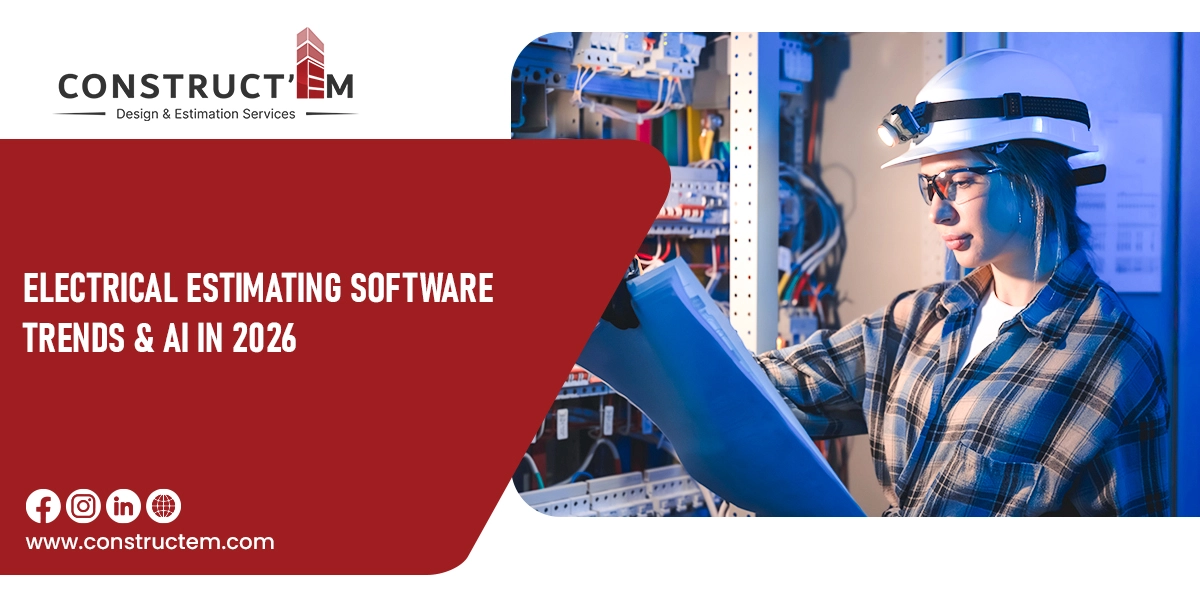
The construction sector is currently navigating a definitive era where traditional workflows converge with high-speed automation. As global supply chains remain unpredictable and project complexity intensifies, electrical estimating service providers must leverage artificial intelligence to protect their margins. This evolution ensures that estimates are no longer mere guesses but are instead precise financial blueprints.
Moving to AI isn’t just about working faster; it’s about changing how we look at project data. In 2026, several big shifts are defining the industry:
Margin compression has made estimating precision essential in 2026. Profit margins are tighter than ever. With a major labor shortage, the industry needs about 439,000 new workers every year; the cost of help is always changing. A single mistake in your estimate can quickly turn a winning bid into a financial headache.
Digital transformation is also reshaping insulation estimation workflows. Insulation estimating services are now a huge part of building smart, energy-efficient structures. As AI data centers grow, we need massive amounts of specialized insulation to keep those cooling systems running perfectly.
Modern services use AI to figure out exactly how much material is needed to meet strict energy laws. This stops contractors from over-buying, which is a big deal as we all try to move toward eco-friendly and ethically sourced materials.
A traditional construction estimation company is no longer just a “side service”. Firms like Constructem are now tech partners that stay connected to their clients in real-time. This year, about 65% of projects require 3D modeling (BIM) as a standard. If an estimation company can’t work inside these 3D worlds, they simply can’t provide the value that modern contractors need.
The market is full of generalists, so focusing on a specific niche is the best way to stand out. Electrical and insulation work involves tricky details like voltage drops or thermal heat leaks that general software often misses.
Specialized firms use historical project datasets to train and validate estimating models to make sure the AI is actually giving useful answers, not just random numbers. This stops communication breakdowns and prevents surprise costs at the end of the project.
| What changed? | Before 2024 | The 2026 AI Standard |
| Speed of Takeoff | 3 to 5 Days | 4 to 6 Hours |
| How much you can bid | Limited by your staff size | Scalable with automation |
| Accuracy Gap | 5% to 8% error | Under 1.5% error |
| Software Setup | Messy Spreadsheets | One Cloud System |
The industry is currently built on three main pillars: automation, staying green, and cybersecurity. As everything moves to the cloud, providers have to prove they are keeping client data safe with high-level security.
Automation has gone from an experiment to something we can’t live without. In 2026, software can look at a drawing and suggest exactly which parts you need based on similar past jobs. This decreases chances of errors, and human estimators spend their time on project strategy instead of counting outlets.
The estimator’s role has evolved significantly. Field knowledge remains essential, but you also need to be an auditor now. This means:
Using tech isn’t a choice anymore. A recent survey showed that most contractors see tech as the only way to survive while many older experts are retiring. If you’re still using old systems, you just won’t be able to give clients the fast, accurate pricing they expect today.
Construction estimation companies are a perfect example of this new era. They combine years of field experience with the latest AI tools. Whether they are doing electrical takeoffs or insulation estimating services, they make sure every bid is backed by solid data. By being transparent and easy to work with, they help contractors win more bids while keeping their profits safe.
2026 has shown us that the future of estimation is all about working together and using smart tech. Electrical estimating service providers who adopt these innovations early aren’t just getting by; they are leading the way. By mixing human intuition with machine speed, the industry is finally reaching a point where near-zero variance estimating is becoming increasingly achievable.
No, AI won’t take your job. It just does repetitive quantity extraction tasks. We still need humans to make the big decisions and double-check the final bid.
The best ones are built right into your takeoff software. They can automatically read drawings and point out if something looks wrong in your electrical plans.
In 2026, everyone is using cloud-based platforms that allow teams to work together in real-time. The best tools catch risks automatically and sync with your 3D models.
It’s not taking jobs but making them better. It handles the data entry so you can focus on the long-term strategy and winning the project.
Constructem combines industry expertise with AI-assisted estimating workflows to deliver detailed and reliable cost assessments.
For the best results, talk to specialists like Constructem. They use high-tech modeling to make sure your project hits all the 2026 energy and insulation laws.




Social Links
days day
hours hour
minutes minute
seconds second
Lock in Flat 30% off before your quote reservation expires.
Precision material takeoffs & cost estimates delivered fast for USA Contractors.