


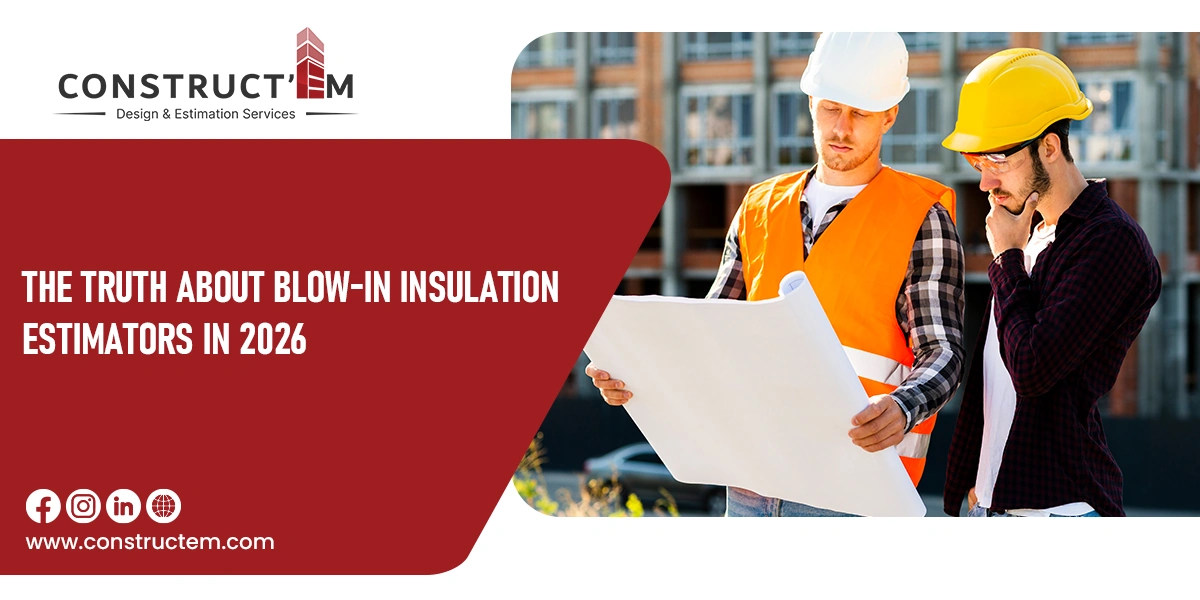
Homeowners and contractors often struggle to predict attic upgrade costs accurately. A blow in insulation estimator provides clarity by calculating material volume and labor requirements in real time. These tools reduce uncertainty by converting square footage into precise bag counts and target R-values. In 2026, shifting material costs and evolving energy regulations increase estimation complexity. As a result, digital calculators have become essential for accurate residential cost estimation.
At first glance, many assume that measuring floor area provides enough data for an accurate bid. However, professional construction insulation estimation requires a deeper look into thermal resistance and structural barriers. You must account for the settling of materials over time, which reduces the effective R-value if you do not add extra depth during the initial installation.
Furthermore, different regions demand specific R-values to meet local building codes. Ignoring the “joist factor” which represents the volume of wood displacement in the attic will inevitably lead to material over-ordering. According to energy.gov, proper installation can save homeowners up to 15% on heating and cooling costs, but only if the initial estimate aligns with the specific climate zone requirements.
A blow-in insulation estimator is a specialized digital tool that calculates the volume of loose-fill material needed to reach a specific thermal goal. Users input the total area of the space and the desired R-value. The software then processes the manufacturer’s coverage chart to determine how many bags of cellulose or fiberglass the project requires.
| Component | Function |
| Square Footage | Defines the total surface area to cover. |
| Current Depth | Measures existing insulation to calculate the “top-off” need. |
| Target R-Value | Determines the thickness required for thermal efficiency. |
| Bag Count | Converts volume into a specific number of purchasable units. |
Modern estimators also factor in the “density” of the blow. Since loose-fill settles after application, the estimator adds a percentage buffer to ensure the attic maintains its performance for decades. This precision minimizes the common mistake of under-insulating, which leads to ice dams and high energy bills.
In 2026, the average cost to blow in insulation for a 1,000-square-foot house ranges between $1,500 and $2,800. While the raw material remains affordable, professional estimates often overlook hidden variables. For instance, many DIY estimators forget to include the rental cost of the blowing machine or the price of baffles for eave ventilation.
Accurate residential cost estimation must include labor for air sealing. If you blow insulation over open gaps, conditioned air will still escape, rendering the new material less effective. Data from Forbes Advisor suggests that labor accounts for nearly 40% of the total project cost. Ignoring these details leads to cost overruns during project execution.
Several technical variables shift the final price of an insulation project. Understanding these factors helps you verify the accuracy of a quote from a subcontractor.
Precise calculations ensure that every dollar directly improves thermal performance and long-term energy efficiency. This is precisely why insulation estimating services are important for the construction industry today; it protects the profit margins of contractors while ensuring homeowner satisfaction.
In contrast, manual estimation relies on “rule of thumb” math, which often leads to 10-15% material waste. In contrast, digital construction insulation estimation tools use real-time data from manufacturers. These platforms update coverage rates based on the specific brand of insulation you purchase.
Digital tools also allow for easy “what-if” scenarios. You can quickly see how much more it costs to move from R-30 to R-60. In a world where material prices fluctuate weekly, the speed of digital software provides a competitive edge for modern firms like Constructem.
You can trust online estimators for a “ballpark” figure, but they rarely replace a physical site audit. However, most online tools assume a perfectly rectangular room with no obstructions. Real-world attics contain chimneys, recessed lighting, and wiring that require careful navigation and specialized sealing.
Use online tools to set your initial budget. However, always consult a professional for the final residential cost estimation. A professional assessment identifies moisture issues or structural weaknesses that a simple web form will never catch.
If an estimate seems too good to be true, it likely is. Watch for these red flags:
Blow-in insulation remains the most cost-effective way to upgrade an existing home’s efficiency. Loose-fill materials deliver high thermal resistance at a significantly lower cost compared to alternatives like spray foam.
Research from the North American Insulation Manufacturers Association (NAIMA) confirms that fiberglass and cellulose are highly sustainable. They often contain up to 80% recycled content. When you use a blow in insulation estimator to get the job right the first time, the energy savings typically pay for the installation within three to five years.
Your insulation estimator needs to produce accurate measurements which will determine your future home comfort and your financial expenses. Your thermal barrier reaches its best performance when you gather exact data instead of taking any shortcuts. The construction management tool Constructem delivers essential professional support which helps clients transform their project estimates into completed work. The process of accurate estimation requires more than simply calculating materials because it determines how efficiently a building will operate throughout its entire lifespan and creates its recurring operational expenses.
In 2026, the typical cost ranges from $1,500 to $2,800. This price includes materials, labor, and the necessary equipment rentals for a standard attic application.
A 25-pound bag usually covers about 40 to 50 square feet at an R-30 level. Always check the specific manufacturer’s chart as density varies by brand.
First, measure your total square footage. Then, determine your target R-value. Finally, use a blow in insulation estimator to divide the area by the bag’s coverage rate.
You typically need about 8 to 10 inches of cellulose or 10 to 14 inches of fiberglass. This depth ensures the home meets basic energy standards.
R4 is better because a higher R-value indicates stronger resistance to heat flow. However, both are very low for modern attic standards which usually require R-38 or higher.
An R-value of 2.5 represents very low thermal resistance. This value is typical for thin materials like single-pane glass or uninsulated wood doors, not attic spaces.
To reach R60, you generally need 17 to 20 inches of cellulose. If you use fiberglass, you may need up to 22 inches of material to achieve this.
R60 insulation value provides significant advantages in cold weather conditions according to research. The system decreases heat loss during extreme winter conditions while maintaining lower indoor temperatures throughout the summer season.
Vacuum insulated panels (VIPs) provide maximum R-value thermal insulation through their minimal thickness design. The closed-cell spray foam system delivers superior R-value insulation performance for regular home applications.
The main disadvantages of this system are both its tendency to settle with time and the possibility of creating a mess during the installation process. The attic space needs professional-grade equipment to maintain proper density throughout its entire area.


Social Links
days day
hours hour
minutes minute
seconds second
Lock in Flat 30% off before your quote reservation expires.
Precision material takeoffs & cost estimates delivered fast for USA Contractors.